


Page 405 -
P. 405
Chapter 9  Business Intelligence Systems
                404
                                                                               Metadata

                                              BI Application


                                                                                         Push
                                    BI Data           BI            BI         BI Server          “Any”
                                    Source         Application   Application                      Device
                                                                   Result                 Pull
                                                                                                                BI users

                               • Operational data  • RFM                                      • Computer
                               • Data warehouse  • OLAP                                       • Mobile devices
                               • Data mart      • Other reports                               • Office and other applications
                               • Content material  • Market basket                            • Cloud services to anything...
                               • Human interviews  • Decision tree
                                                • Other data mining
                                                • Content indexing
                                                • RSS feed
                                                • Expert system
                                                                       BI System
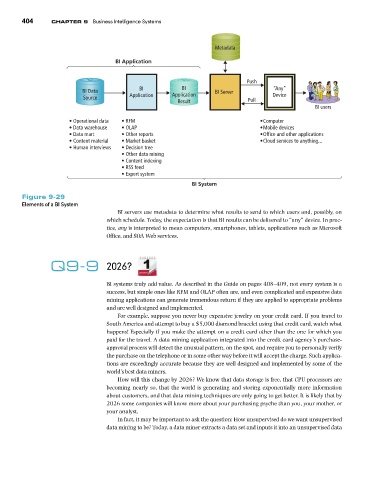
                Figure 9-29
                Elements of a BI System
                                               BI servers use metadata to determine what results to send to which users and, possibly, on
                                            which schedule. Today, the expectation is that BI results can be delivered to “any” device. In prac-
                                            tice, any is interpreted to mean computers, smartphones, tablets, applications such as Microsoft
                                            Office, and SOA Web services.


                         Q9-9               2026?


                                            BI systems truly add value. As described in the Guide on pages 408–409, not every system is a
                                            success, but simple ones like RFM and OLAP often are, and even complicated and expensive data
                                            mining applications can generate tremendous return if they are applied to appropriate problems
                                            and are well designed and implemented.
                                               For example, suppose you never buy expensive jewelry on your credit card. If you travel to
                                            South America and attempt to buy a $5,000 diamond bracelet using that credit card, watch what
                                            happens! Especially if you make the attempt on a credit card other than the one for which you
                                            paid for the travel. A data mining application integrated into the credit card agency’s purchase-
                                            approval process will detect the unusual pattern, on the spot, and require you to personally verify
                                            the purchase on the telephone or in some other way before it will accept the charge. Such applica-
                                            tions are exceedingly accurate because they are well designed and implemented by some of the
                                            world’s best data miners.
                                               How will this change by 2026? We know that data storage is free, that CPU processors are
                                            becoming nearly so,  that  the world is  generating and storing exponentially more information
                                            about customers, and that data mining techniques are only going to get better. It is likely that by
                                            2026 some companies will know more about your purchasing psyche than you, your mother, or
                                            your analyst.
                                               In fact, it may be important to ask the question: How unsupervised do we want unsupervised
                                            data mining to be? Today, a data miner extracts a data set and inputs it into an unsupervised data

