


Page 403 -
P. 403
Chapter 9  Business Intelligence Systems
                402
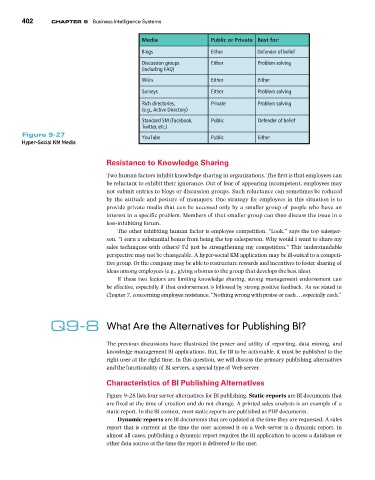
                                                       Media                  Public or Private Best for:
                                                       Blogs                  Either         Defender of belief
                                                       Discussion groups      Either         Problem solving
                                                       (including FAQ)

                                                       Wikis                  Either         Either
                                                       Surveys                Either         Problem solving

                                                       Rich directories,      Private        Problem solving
                                                       (e.g., Active Directory)
                                                       Standard SM (Facebook,   Public       Defender of belief
                                                       Twitter, etc.)
                Figure 9-27                            YouTube                Public         Either
                Hyper-Social KM Media

                                            Resistance to Knowledge Sharing

                                            Two human factors inhibit knowledge sharing in organizations. The first is that employees can
                                            be reluctant to exhibit their ignorance. Out of fear of appearing incompetent, employees may
                                            not submit entries to blogs or discussion groups. Such reluctance can sometimes be reduced
                                            by the attitude and posture of managers. One strategy for employees in this situation is to
                                            provide private media that can be accessed only by a smaller group of people who have an
                                            interest in a specific problem. Members of that smaller group can then discuss the issue in a
                                            less- inhibiting forum.
                                               The other inhibiting human factor is employee competition. “Look,” says the top salesper-
                                            son. “I earn a substantial bonus from being the top salesperson. Why would I want to share my
                                            sales  techniques with others? I’d just be strengthening my competition.” This understandable
                                            perspective may not be changeable. A hyper-social KM application may be ill-suited to a competi-
                                            tive group. Or the company may be able to restructure rewards and incentives to foster sharing of
                                            ideas among employees (e.g., giving a bonus to the group that develops the best idea).
                                               If  these  two factors are limiting knowledge sharing, strong management endorsement can
                                            be effective, especially if that endorsement is followed by strong positive feedback. As we stated in
                                            Chapter 7, concerning employee resistance, “Nothing wrong with praise or cash . . . especially cash.”


                         Q9-8               What Are the Alternatives for Publishing BI?


                                            The previous discussions have illustrated the power and utility of reporting, data mining, and
                                            knowledge management BI applications. But, for BI to be actionable, it must be published to the
                                            right user at the right time. In this question, we will discuss the primary publishing alternatives
                                            and the functionality of BI servers, a special type of Web server.

                                            Characteristics of BI Publishing Alternatives

                                            Figure 9-28 lists four server alternatives for BI publishing. Static reports are BI documents that
                                            are fixed at the time of creation and do not change. A printed sales analysis is an example of a
                                            static report. In the BI context, most static reports are published as PDF documents.
                                               Dynamic reports are BI documents that are updated at the time they are requested. A sales
                                            report that is current at the time the user accessed it on a Web server is a dynamic report. In
                                            almost all cases, publishing a dynamic report requires the BI application to access a database or
                                            other data source at the time the report is delivered to the user.

