


Page 399 -
P. 399
Chapter 9  Business Intelligence Systems
                398
                                               Before we turn to those specific technologies, however, consider the overall goals and benefits
                                            of KM. KM benefits organizations in two fundamental ways:
                                               •  Improve process quality
                                               •  Increase team strength

                                               As you know,  process quality is measured  by effectiveness and efficiency, and  knowledge
                                            management can improve both. KM enables employees to share knowledge with each other and
                                            with customers and other partners. By doing so, it enables the employees in the organization to
                                            better achieve the organization’s strategy. At the same time, sharing knowledge enables employ-
                                            ees to solve problems more quickly and to otherwise accomplish work with less time and other
                                            resources, hence improving process efficiency. 17
                                               Additionally, recall from Chapter 2 that successful teams not only accomplish their assigned tasks,
                                            they also grow in capability, both as a team and as individuals. By sharing knowledge, team members
                                            learn from one another, avoid making repetitive mistakes, and grow as business professionals.
                                               For example, consider the help desk at any organization, say, one that provides support for
                                              electronic components like iPhones. When a user has a problem with an iPhone, he or she might
                                            contact Apple support for help. The customer service department has, collectively, seen just about
                                            any problem that can ever occur with an iPhone. The organization, as a whole, knows how to
                                            solve the user’s problem. However, that is no guarantee that a particular support representative
                                            knows how to solve that problem. The goal of KM is to enable employees to be able to use knowl-
                                            edge possessed collectively by people in the organization. By doing so, both process quality and
                                            team capability improve.

                                            What Are Expert Systems?

                                            The earliest KM systems, called expert systems, attempted to directly capture employee expertise.
                                            They existed long before social media and in fact were in use long before the Internet.
                                               Expert systems are rule-based systems that encode human knowledge in the form of If/
                                            Then rules. Such rules are statements that specify if a particular condition exists, then to take
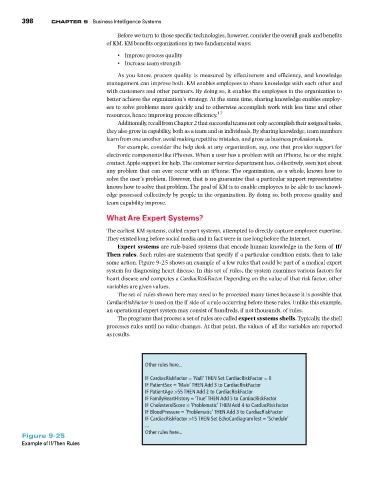
                                            some action. Figure 9-25 shows an example of a few rules that could be part of a medical expert
                                            system for diagnosing heart disease. In this set of rules, the system examines various factors for
                                            heart disease and computes a CardiacRiskFactor. Depending on the value of that risk factor, other
                                            variables are given values.
                                               The set of rules shown here may need to be processed many times because it is possible that
                                            CardiacRiskFactor is used on the If side of a rule occurring before these rules. Unlike this example,
                                            an operational expert system may consist of hundreds, if not thousands, of rules.
                                               The programs that process a set of rules are called expert systems shells. Typically, the shell
                                            processes rules until no value changes. At that point, the values of all the variables are reported
                                            as results.


                                                        Other rules here...

                                                        IF CardiacRiskFactor = ‘Null’ THEN Set CardiacRiskFactor = 0
                                                        IF PatientSex = ‘Male’ THEN Add 3 to CardiacRiskFactor
                                                        IF PatientAge >55 THEN Add 2 to CardiacRiskFactor
                                                        IF FamilyHeartHistory = ‘True’ THEN Add 5 to CardiacRiskFactor
                                                        IF CholesterolScore = ‘Problematic’ THEN Add 4 to CardiacRiskFactor
                                                        IF BloodPressure = ‘Problematic’ THEN Add 3 to CardiacRiskFactor
                                                        IF CardiacRiskFactor >15 THEN Set EchoCardiagramTest = ‘Schedule’
                                                        ...
                                                        Other rules here...
                Figure 9-25
                Example of If/Then Rules

