


Page 395 -
P. 395
Chapter 9  Business Intelligence Systems
                394


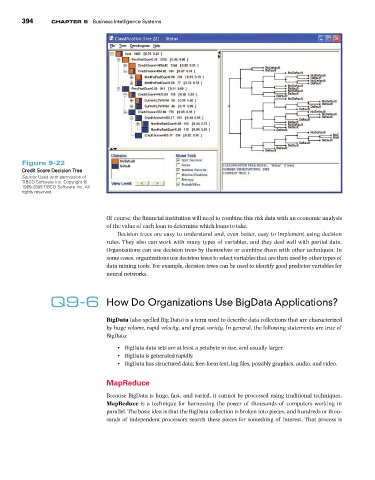
                Figure 9-22
                Credit Score Decision Tree
                Source: Used with permission of
                TIBCO Software Inc. Copyright ©
                1999-2005 TIBCO Software Inc. All
                rights reserved.


                                            Of course, the financial institution will need to combine this risk data with an economic analysis
                                            of the value of each loan to determine which loans to take.
                                               Decision  trees are easy  to understand and, even better, easy  to implement using decision
                                            rules. They also can work with many types of variables, and they deal well with partial data.
                                            Organizations can use decision trees by themselves or combine them with other techniques. In
                                            some cases, organizations use decision trees to select variables that are then used by other types of
                                            data mining tools. For example, decision trees can be used to identify good predictor variables for
                                            neural networks.


                         Q9-6               How Do Organizations Use BigData Applications?


                                            BigData (also spelled Big Data) is a term used to describe data collections that are characterized
                                            by huge volume, rapid velocity, and great variety. In general, the following statements are true of
                                            BigData:
                                               •  BigData data sets are at least a petabyte in size, and usually larger.
                                               •  BigData is generated rapidly.
                                               •  BigData has structured data, free-form text, log files, possibly graphics, audio, and video.


                                            MapReduce

                                            Because BigData is huge, fast, and varied, it cannot be processed using traditional techniques.
                                            MapReduce is a  technique for harnessing  the  power of  thousands of computers working in
                                              parallel. The basic idea is that the BigData collection is broken into pieces, and hundreds or thou-
                                            sands of independent processors search these pieces for something of interest. That process is

