


Page 393 -
P. 393
Chapter 9  Business Intelligence Systems
                392


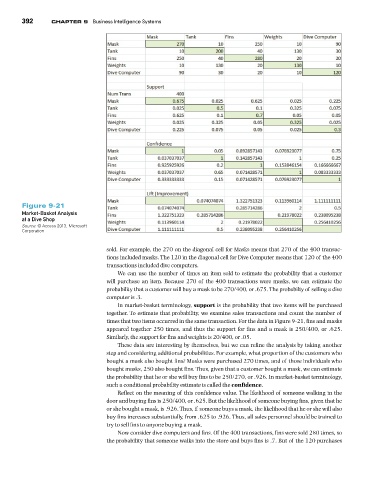
                Figure 9-21
                Market-Basket Analysis
                at a Dive Shop
                Source: © Access 2013, Microsoft
                Corporation

                                            sold. For example, the 270 on the diagonal cell for Masks means that 270 of the 400 transac-
                                            tions included masks. The 120 in the diagonal cell for Dive Computer means that 120 of the 400
                                              transactions included dive computers.
                                               We can use the number of times an item sold to estimate the probability that a customer
                                            will  purchase an item. Because 270 of the 400 transactions were masks, we can estimate the
                                              probability that a customer will buy a mask to be 270/400, or .675. The probabilty of selling a dive
                                            computer is .3.
                                               In market-basket terminology, support is the probability that two items will be purchased
                                            together. To estimate that probability, we examine sales transactions and count the number of
                                            times that two items occurred in the same transaction. For the data in Figure 9-21, fins and masks
                                            appeared together 250 times,  and thus the  support for  fins and a mask is 250/400, or .625.
                                            Similarly, the support for fins and weights is 20/400, or .05.
                                               These data are interesting by themselves, but we can refine the analysis by taking another
                                            step and considering additional probabilities. For example, what proportion of the customers who
                                            bought a mask also bought fins? Masks were purchased 270 times, and of those individuals who
                                            bought masks, 250 also bought fins. Thus, given that a customer bought a mask, we can estimate
                                            the probability that he or she will buy fins to be 250/270, or .926. In market-basket terminology,
                                            such a conditional probability estimate is called the confidence.
                                               Reflect on the meaning of this confidence value. The likelihood of someone walking in the
                                            door and buying fins is 250/400, or .625. But the likelihood of someone buying fins, given that he
                                            or she bought a mask, is .926. Thus, if someone buys a mask, the likelihood that he or she will also
                                            buy fins increases substantially, from .625 to .926. Thus, all sales personnel should be trained to
                                            try to sell fins to anyone buying a mask.
                                               Now consider dive computers and fins. Of the 400 transactions, fins were sold 280 times, so
                                            the probability that someone walks into the store and buys fins is .7. But of the 120 purchases

