


Page 391 -
P. 391
Chapter 9  Business Intelligence Systems
                390
                         Q9-5               How Do Organizations Use Data Mining
                                            Applications?


                                            Data mining is the application of statistical techniques to find patterns and relationships among
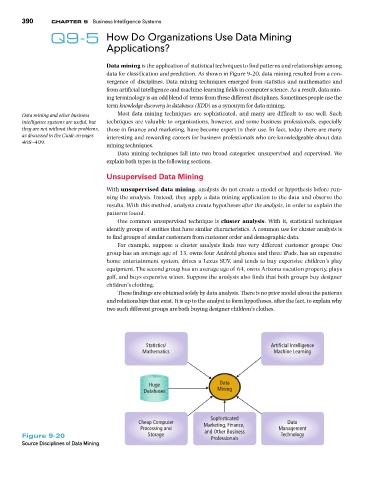
                                            data for classification and prediction. As shown in Figure 9-20, data mining resulted from a con-
                                            vergence of disciplines. Data mining techniques emerged from statistics and mathematics and
                                            from artificial intelligence and machine-learning fields in computer science. As a result, data min-
                                            ing terminology is an odd blend of terms from these different disciplines. Sometimes people use the
                                            term knowledge discovery in databases (KDD) as a synonym for data mining.
                Data mining and other business   Most data mining  techniques are sophisticated, and many are difficult  to use  well. Such
                intelligence systems are useful, but     techniques are valuable to organizations, however, and some business professionals, especially
                they are not without their problems,   those in finance and marketing, have become expert in their use. In fact, today there are many
                as discussed in the Guide on pages   interesting and rewarding careers for business professionals who are knowledgeable about data
                408–409.
                                            mining techniques.
                                               Data mining  techniques fall into  two broad categories: unsupervised and supervised. We
                                            explain both types in the following sections.

                                            Unsupervised Data Mining

                                            With unsupervised data mining, analysts do not create a model or hypothesis before run-
                                            ning the analysis. Instead, they apply a data mining application to the data and observe the
                                            results. With this method, analysts create hypotheses after the analysis, in order to explain the
                                            patterns found.
                                               One common unsupervised  technique is  cluster analysis. With it, statistical  techniques
                                            identify groups of entities that have similar characteristics. A common use for cluster analysis is
                                            to find groups of similar customers from customer order and demographic data.
                                               For example, suppose a cluster analysis finds  two  very different customer  groups: One
                                            group has an average age of 33, owns four Android phones and three iPads, has an expensive
                                            home entertainment system, drives a Lexus SUV, and tends to buy expensive children’s play
                                            equipment. The second group has an average age of 64, owns Arizona vacation property, plays
                                            golf, and buys expensive wines. Suppose the analysis also finds that both groups buy designer
                                            children’s clothing.
                                               These findings are obtained solely by data analysis. There is no prior model about the patterns
                                            and relationships that exist. It is up to the analyst to form hypotheses, after the fact, to explain why
                                            two such different groups are both buying designer children’s clothes.


                                                        Statistics/                              Artificial Intelligence
                                                       Mathematics                                Machine Learning


                                                         Huge                    Data
                                                        Databases               Mining


                                                                              Sophisticated
                                                      Cheap Computer       Marketing, Finance,         Data
                                                       Processing and       and Other Business      Management
                Figure 9-20                              Storage              Professionals         Technology
                Source Disciplines of Data Mining

