


Page 401 -
P. 401
Chapter 9  Business Intelligence Systems
                400


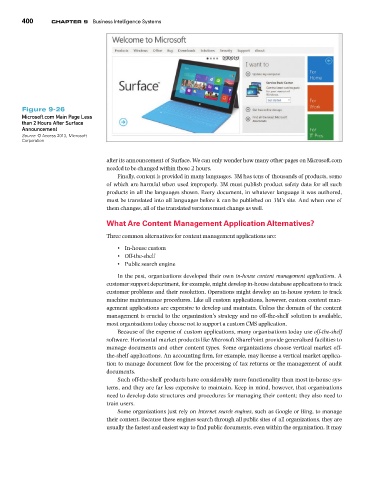
                Figure 9-26
                Microsoft.com Main Page Less
                than 2 Hours After Surface
                Announcement
                Source: © Access 2013, Microsoft
                Corporation


                                            after its announcement of Surface. We can only wonder how many other pages on Microsoft.com
                                            needed to be changed within those 2 hours.
                                               Finally, content is provided in many languages. 3M has tens of thousands of products, some
                                            of which are harmful when used improperly. 3M must publish product safety data for all such
                                            products in all the languages shown. Every document, in whatever language it was authored,
                                            must be translated into all languages before it can be published on 3M’s site. And when one of
                                            them changes, all of the translated versions must change as well.

                                            What Are Content Management Application Alternatives?
                                            Three common alternatives for content management applications are:

                                               •  In-house custom
                                               •  Off-the-shelf
                                               •  Public search engine

                                               In the past, organizations developed their own in-house content management applications. A
                                            customer support department, for example, might develop in-house database applications to track
                                            customer problems and their resolution. Operations might develop an in-house system to track
                                            machine maintenance procedures. Like all custom applications, however, custom content man-
                                            agement applications are expensive to develop and maintain. Unless the domain of the content
                                            management is crucial to the organization’s strategy and no off-the-shelf solution is available,
                                            most organizations today choose not to support a custom CMS application.
                                               Because of the expense of custom applications, many organizations today use off-the-shelf
                                            software. Horizontal market products like Microsoft SharePoint provide generalized facilities to
                                            manage documents and other content types. Some organizations choose vertical market off-
                                            the-shelf applications. An accounting firm, for example, may license a vertical market applica-
                                            tion to manage document flow for the processing of tax returns or the management of audit
                                            documents.
                                               Such off-the-shelf products have considerably more functionality than most in-house sys-
                                            tems, and they are far less expensive to maintain. Keep in mind, however, that organizations
                                            need to develop data structures and procedures for managing their content; they also need to
                                            train users.
                                               Some organizations just rely on Internet search engines, such as Google or Bing, to manage
                                            their content. Because these engines search through all public sites of all organizations, they are
                                            usually the fastest and easiest way to find public documents, even within the organization. It may

