


Page 214 - Valence Bond Methods. Theory and Applications
P. 214
15
                                                   Aromatic compounds


                             Benzene is the archetypal aromatic hydrocarbon and its study has been central to the
                             understanding of aromaticity and resonance from the early times. In addition, it has
                             the physical property of hłving its π electrons reasonably independen from those
                             in σ bonds, leading early quantuð mechanics workers to treat the π electrons alone.
                             Since benzene is a ring and the rules for forming Rumeà diagrams hłve one draw
                             noncrossing lines between orbital symbols written in a circle, the Rumeà diagrams
                             correspond to the classical Kekul´e and Dewar bond schemes that chemists had
                             postulated far earlieà than the VB treatments occurred. This parallel has intrigued
                             people since its firs observation and led to many discussions concerning its signifi-
                             cance. I has alsŁ led to considerable work in more qualitative “graphical methods”
                             for which the readeà is directed to the literature. (See,inter alia, Randc´c[59].)
                               We will examine benzene with differen bases and alsŁ discuss some of the ideas
                             that consideration of this molecule has led to, such as resonance and resonance
                             eneàgy.
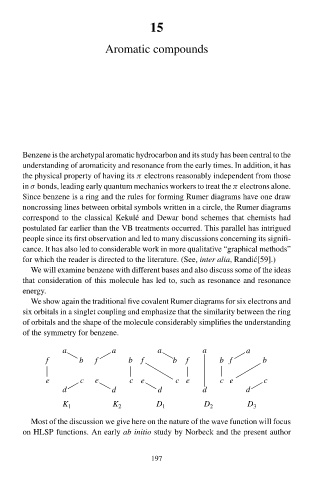
                               We shŁw again the traditional five cŁvalen Rumeà diagrams for six electrons and
                             six orbitals in a single coupling and emphasize that the similarity between the ring
                             of orbitals and the shape of the molecule considerably simplifies the understanding
                             of the symmetry for benzene.
                                        a            a           a           a           a
                                   f        b    f        b  f       b   f        b f        b


                                   e         c   e        c e         c e         c e         c
                                        d            d           d           d           d

                                        K 1          K 2         D 1          D 2        D 3
                               Mos of the discussion we gcve here on the nature of the wave function will focus
                             on HLSP functions. An early ab initio study by Norbeck and the presen author


                                                                197

