


Page 108 - Volcanic Textures A Guide To The Interpretation of Textures In Volcanic Rocks
P. 108
GENETIC CATEGORY                           DOMINANT TRANSPORT
                                              Mass-flow                Traction              Suspension
                primary pyroclastic deposits   • pyroclastic flows    • pyroclastic surges    • fallout
                                                                                        • water-settled fallout
                resedimented syn-eruptive   • turbidity currents   • fluvial and shallow   • suspension associated
                volcaniclastic deposits and   • debris flows, mud flows   subaqueous currents   with mass flows
                volcanogenic sedimentary   • grain flows       • waves                  • hemipelagic suspension
                deposits               • density-modified grain flows
                                       • slides, debris avalanches


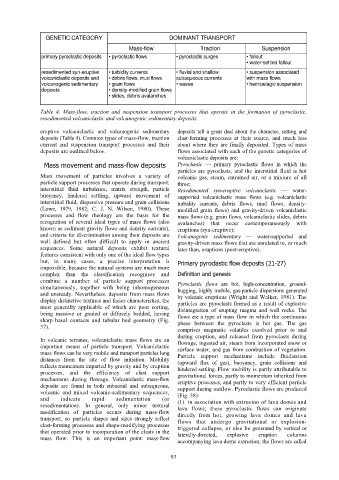
               Table 4.  Mass-flow, traction and suspension transport  processes that operate in the formation of pyroclastic,
               resedimented volcaniclastic and volcanogenic sedimentary deposits.

               eruptive volcaniclastic and volcanogenic  sedimentary   deposits tell a great deal about the character, setting and
               deposits (Table 4). Common types of mass-flow, traction   clast-forming processes at  their source, and much  less
               current  and suspension transport  processes and their   about where they are finally deposited. Types of mass
               deposits are outlined below.                    flows associated with each of the genetic categories of
                                                               volcaniclastic deposits are:
                Mass movement and mass-flow deposits           Pyroclastic  —  primary pyroclastic flows  in which  the
                                                               particles  are  pyroclasts, and  the interstitial fluid is  hot
               Mass  movement of particles involves a variety of   volcanic  gas,  steam, entrained air, or a mixture  of all
               particle support processes that operate during transport:   three;
               interstitial  fluid turbulence,  matrix strength, particle   Resedimented syn-eruptive volcaniclastic  — water-
               buoyancy, hindered settling, upward movement of   supported  volcaniclastic mass flows  (e.g.  volcaniclastic
               interstitial fluid, dispersive pressure and grain collisions   turbidity  currents,  debris flows, mud flows, density-
               (Lowe, 1979, 1982; C. J. N.  Wilson,  1980).  These   modified grain flows) and  gravity-driven  volcaniclastic
               processes and flow rheology are the  basis for the   mass flows (e.g. grain flows, volcaniclastic slides, debris
               recognition  of several ideal  types of mass flows (also   avalanches) that occur  contemporaneously with
               known as sediment gravity flows and density currents),   eruptions (syn-eruptive);
               and criteria for discrimination among their deposits are   Volcanogenic sedimentary  — water-supported and
               well defined  but often  difficult to apply in ancient   gravity-driven mass flows that are unrelated to, or much
               sequences.  Some natural deposits exhibit textural   later than, eruptions (post-eruptive).
               features consistent with only one of the ideal flow types
               but, in many cases, a  precise  interpretation  is   Primary pyroclastic flow deposits (21-27)
               impossible, because the natural systems are much more
               complex than the classification recognises  and   Definition and genesis
               combine  a number of particle  support processes   Pyroclastic flows  are  hot, high-concentration, ground-
               simultaneously,  together with being  inhomogeneous   hugging, highly mobile, gas-particle dispersions generated
               and unsteady. Nevertheless, deposits from  mass flows   by volcanic eruptions (Wright and Walker, 1981). The
               display distinctive textures and facies characteristics, the   particles are pyroclasts formed as a result of explosive
               most generally  applicable of which  are poor sorting,   disintegration  of  erupting  magma and wall rocks. The
               being massive or graded or diffusely bedded,  having   flows are a type of mass flow in which the continuous
               sharp  basal  contacts and  tabular bed geometry  (Fig.   phase  between  the  pyroclasts  is hot gas. The gas
               37).                                            comprises  magmatic volatiles exsolved  prior  to  and
                                                               during eruption, and released from pyroclasts  during
               In  volcanic terranes,  volcaniclastic  mass flows are an   flowage, ingested air, steam from incorporated snow or
               important  means of particle  transport. Volcaniclastic   surface water, and gas from combustion of vegetation.
               mass flows can be very mobile and transport particles long   Particle  support mechanisms include  fluidisation
               distances  from the site of flow initiation. Mobility   (upward  flux of gas), buoyancy, grain collisions and
               reflects momentum imparted by gravity and by eruption   hindered settling. Flow mobility is partly attributable to
               processes, and the efficiency of clast support   gravitational forces, partly to momentum inherited from
               mechanisms during  flowage. Volcaniclastic  mass-flow   eruptive processes, and partly to very efficient particle
               deposits  are found in both subaerial and  subaqueous,   support during outflow. Pyroclastic flows are produced
               volcanic  and mixed volcanic-sedimentary  sequences,   (Fig. 38):
               and    indicate   rapid    sedimentation   (or  (1)  in association with extrusion of lava domes and
               resedimentation). In general, only  minor textural   lava  flows; these pyroclastic flows can originate
               modification  of  particles occurs during  mass-flow   directly  from  hot, growing lava domes and lava
               transport,  so  particle  shapes and sizes strongly reflect   flows that undergo gravitational  or  explosion-
               clast-forming processes and shape-modifying processes   triggered collapse, or else be generated by vertical or
               that operated prior to incorporation of the clasts in the   laterally-directed,  explosive  eruption  columns
               mass flow. This is an important point:  mass-flow
                                                               accompanying lava dome extrusion; the flows are called

                                                             93

