


Page 113 - Volcanic Textures A Guide To The Interpretation of Textures In Volcanic Rocks
P. 113
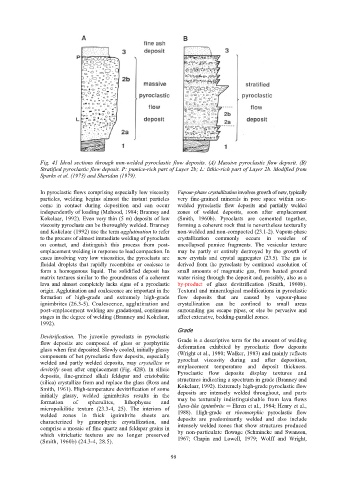
Fig. 41 Ideal sections through non-welded pyroclastic flow deposits. (A) Massive pyroclastic flow deposit. (B)
               Stratified pyroclastic flow deposit. P: pumice-rich part of Layer 2b; L: lithic-rich part of Layer 2b. Modified from
               Sparks et al. (1973) and Sheridan (1979).

               In pyroclastic flows comprising especially low viscosity   Vapour-phase crystallization involves growth of new, typically
               particles, welding  begins almost the instant  particles   very fine-grained minerals in pore  space within non-
               come in contact during deposition and  can occur   welded  pyroclastic flow  deposits  and partially welded
               independently of loading (Mahood, 1984; Branney and   zones  of welded deposits,  soon  after  emplacement
               Kokelaar, 1992). Even very thin (5 m) deposits of low   (Smith, 1960b). Pyroclasts are  cemented  together,
               viscosity pyroclasts can be thoroughly welded. Branney   forming a coherent rock that is nevertheless texturally
               and Kokelaar (1992) use the term agglutination to refer   non-welded and non-compacted (23.1-2). Vapour-phase
               to the process of almost immediate welding of pyroclasts   crystallization commonly occurs in vesicles  of
               on contact, and distinguish this  process  from  post-  uncollapsed pumice fragments. The vesicular texture
               emplacement welding in response to load compaction. In   may be partly or entirely destroyed  by the growth of
               cases involving very low viscosities, the pyroclasts  are   new crystals and crystal aggregates (23.5). The gas is
               fluidal droplets  that rapidly  recombine or  coalesce  to   derived from  the pyroclasts by continued exsolution of
               form  a homogenous liquid.  The solidified deposit has   small  amounts  of magmatic gas, from heated  ground
               matrix textures similar to the groundmass of a coherent   water rising through the deposit and, possibly, also as a
               lava and almost completely lacks signs of  a pyroclastic   by-product of glass devitrification (Smith, 1960b).
               origin. Agglutination and coalescence are important in the   Textural and mineralogical modifications in pyroclastic
               formation  of high-grade and extremely high-grade   flow deposits that are  caused by vapour-phase
               ignimbrites (26.3-5). Coalescence, agglutination and   crystallization can  be confined to  small areas
               post-emplacement welding are gradational, continuous   surrounding  gas escape pipes, or else be pervasive and
               stages in the degree of welding (Branney and Kokelaar,   affect extensive, bedding-parallel zones.
               1992).
                                                               Grade
               Devitrification.  The juvenile pyroclasts  in pyroclastic
               flow  deposits  are composed of glass or  porphyritic   Grade is a descriptive term for the amount of welding
               glass when first deposited. Slowly cooled, initially glassy   deformation exhibited  by pyroclastic flow  deposits
               components of hot pyroclastic flow deposits, especially   (Wright et al., 1980; Walker, 1983) and mainly reflects
               welded and partly welded deposits, may  crystallize  or   pyroclast viscosity during  and after  deposition,
               devitrify soon after emplacement (Fig. 42B). In silicic   emplacement  temperature and deposit thickness.
               deposits,  fine-grained  alkali feldspar and cristobalite   Pyroclastic flow  deposits display  textures  and
               (silica) crystallize from and replace the glass (Ross and   structures indicating a spectrum in grade (Branney and
               Smith, 1961). High-temperature devitrification of some   Kokelaar, 1992). Extremely high-grade pyroclastic flow
               initially glassy, welded ignimbrites results  in  the   deposits are intensely welded throughout, and  parts
               formation   of   spherulites,  lithophysae  and  may be  texturally  indistinguishable from lava flows
               micropoikilitic texture (23.3-4, 25). The  interiors  of   (lava-like ignimbrite ─ Ekren et al., 1984; Henry et al.,
               welded  zones in thick ignimbrite sheets  are   1988). High-grade or  rheomorphic  pyroclastic flow
               characterized by granophyric  crystallization,  and   deposits are predominantly  welded and also include
               comprise a mosaic of fine quartz and feldspar grains in   intensely welded zones that show structures produced
               which vitriclastic textures  are no  longer  preserved   by  non-particulate  flowage  (Schmincke and Swanson,
               (Smith, 1960b) (24.3-4, 28.5).                  1967; Chapin and Lowell, 1979; Wolff and Wright,

                                                             98

