


Page 118 - Volcanic Textures A Guide To The Interpretation of Textures In Volcanic Rocks
P. 118
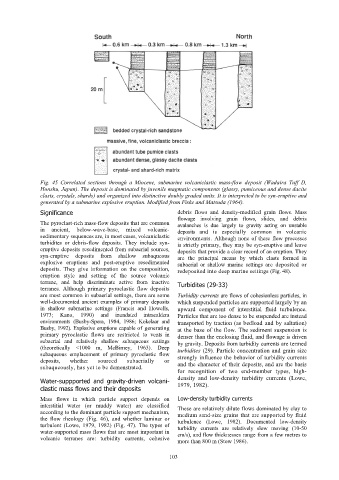
Fig.  45 Correlated sections  through a Miocene, submarine volcaniclastic mass-flow  deposit  (Wadaira  Tuff D,
               Honshu, Japan). The deposit is dominated by juvenile magmatic components (glassy, pumiceous and dense dacite
               clasts, crystals, shards) and organized into distinctive doubly graded units. It is interpreted to be syn-eruptive and
               generated by a submarine explosive eruption. Modified from Fiske and Matsuda (1964).
               Significance                                    debris flows and density-modified grain flows.  Mass
                                                               flowage  involving grain flows, slides,  and debris
               The pyroclast-rich mass-flow deposits that are common   avalanches is due largely to gravity acting on  unstable
               in  ancient, below-wave-base, mixed  volcanic-  deposits  and is especially common in volcanic
               sedimentary sequences are, in most cases, volcaniclastic   environments.  Although none of these flow processes
               turbidites or  debris-flow deposits. They include syn-  is strictly primary, they may be syn-eruptive and leave
               eruptive deposits resedimented from subaerial sources,   deposits that provide a clear record of an eruption. They
               syn-eruptive  deposits  from shallow subaqueous   are the principal  means by  which clasts formed in
               explosive eruptions and post-eruptive  resedimented   subaerial or shallow  marine settings are  deposited  or
               deposits. They give information  on the  composition,   redeposited into deep marine settings (Fig. 48).
               eruption  style and setting of the source  volcanic
               terrane, and help discriminate active from  inactive   Turbidites (29-33)
               terranes. Although primary  pyroclastic flow deposits
               are most common in subaerial settings, there are some   Turbidity currents are flows of cohesionless particles, in
               well-documented ancient  examples of primary deposits   which suspended particles are supported largely by an
               in  shallow  submarine settings  (Francis and Howells,   upward  component of interstitial fluid  turbulence.
               1973; Kano, 1990) and  inundated  intracaldera   Particles that are too dense to be suspended are instead
               environments (Busby-Spera, 1984,  1986;  Kokelaar  and   transported by traction (as bedload and by saltation)
               Busby, 1992). Explosive eruptions capable of  generating   at the base of the flow. The sediment suspension is
               primary pyroclastic flows are restricted  to  vents  in   denser than the enclosing fluid, and flowage is driven
               subaerial and relatively shallow subaqueous settings   by gravity. Deposits from turbidity currents are termed
               (theoretically <1000 m, McBirney, 1963).  Deep   turbidites (29). Particle concentration and grain size
               subaqueous emplacement of primary  pyroclastic flow   strongly influence the behavior of turbidity currents
               deposits,  whether  sourced    subaerially  or
               subaqueously, has yet to be demonstrated.       and the character of their deposits, and are the basis
                                                               for recognition of two end-member  types,  high-
               Water-suppported and  gravity-driven volcani-   density and low-density  turbidity  currents  (Lowe,
                                                               1979, 1982).
               clastic mass flows and their deposits

               Mass flows in which  particle support depends on   Low-density turbidity currents
               interstitial  water  (or muddy  water) are classified   These are relatively dilute flows dominated by clay to
               according to the dominant particle support mechanism,   medium sand-size grains that are supported by fluid
               the flow rheology (Fig. 46),  and whether laminar or   turbulence (Lowe, 1982).  Documented low-density
               turbulent (Lowe, 1979, 1982) (Fig.  47). The types of   turbidity  currents are relatively slow  moving (10-50
               water-supported mass flows that are most important in   cm/s), and flow thicknesses range from a few metres to
               volcanic terranes are: turbidity currents,  cohesive
                                                               more than 800 m (Stow 1986).

                                                            103

