


Page 122 - Volcanic Textures A Guide To The Interpretation of Textures In Volcanic Rocks
P. 122
Cohesive debris flows, volcaniclastic debris    In general, debris-flow deposits are very poorly sorted,
               flows and their deposits (34)                   consisting  of particles  ranging  from clay to cobble  or
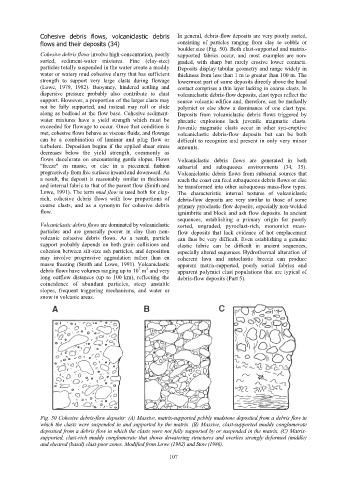
                                                               boulder size (Fig. 50). Both clast-supported and matrix-
               Cohesive debris flows involve high-concentration, poorly   supported  fabrics occur, and  most  examples are  non-
               sorted, sediment-water  mixtures. Fine  (clay-size)   graded,  with  sharp  but rarely erosive lower contacts.
               particles totally suspended in the water create a muddy   Deposits display tabular geometry and range widely in
               water or watery mud cohesive slurry that has sufficient   thickness from less than 1 m to greater than 100 m. The
               strength  to  support very large clasts during flowage   lowermost part of some deposits directly above the basal
               (Lowe,  1979, 1982).  Buoyancy, hindered settling and   contact comprises a thin layer lacking in coarse clasts. In
               dispersive pressure probably also  contribute  to  clast   volcaniclastic debris-flow deposits, clast types reflect the
               support. However, a proportion of the larger clasts may   source volcanic edifice and, therefore, can be markedly
               not be fully supported, and instead  may roll  or  slide   polymict or else show a dominance of one clast type.
               along as bedload at the flow base. Cohesive sediment-  Deposits from volcaniclastic debris flows  triggered  by
               water  mixtures have a yield strength which  must be   phreatic explosions lack  juvenile magmatic clasts.
               exceeded for flowage to occur. Once that condition is   Juvenile magmatic clasts occur in  other  syn-eruptive
               met, cohesive flows behave as viscous fluids, and flowage   volcaniclastic debris-flow deposits  but can  be both
               can  be  a  combination of  laminar and plug flow or   difficult to recognize and present  in only  very  minor
               turbulent.  Deposition begins  if the applied  shear stress   amounts.
               decreases  below  the yield strength, commonly as
               flows decelerate on encountering gentle slopes. Flows   Volcaniclastic debris flows are generated in both
               "freeze" en  masse, or else in  a  piecemeal  fashion   subaerial  and subaqueous environments (34,  35).
               progressively from free surfaces inward and downward. As   Volcaniclastic  debris flows from subaerial sources that
               a result, the  deposit is reasonably similar in  thickness   reach the coast can feed subaqueous debris flows or else
               and internal fabric to that of the parent flow (Smith and   be transformed into other subaqueous mass-flow types.
               Lowe, 1991). The term mud flow is used both for clay-  The characteristic internal  textures  of  volcaniclastic
               rich, cohesive debris  flows with low  proportions  of   debris-flow deposits are very  similar  to  those  of  some
               coarse  clasts,  and as a  synonym for cohesive  debris   primary pyroclastic flow deposits, especially non-welded
               flow.                                           ignimbrite and block and ash flow deposits. In ancient
                                                               sequences, establishing a primary origin for poorly
               Volcaniclastic debris flows are dominated by volcaniclastic   sorted, ungraded, pyroclast-rich,  monomict  mass-
               particles and  are generally  poorer in clay than non-  flow  deposits that lack  evidence  of hot emplacement
               volcanic  cohesive debris flows.  As a result, particle   can  thus be very difficult. Even establishing a genuine
               support probably depends on both grain collisions and   clastic fabric can be  difficult  in  ancient  sequences,
               cohesion between silt-size ash particles, and deposition   especially altered sequences. Hydrothermal alteration of
               may  involve progressive aggradation rather than en   coherent lava and autoclastic breccia  can  produce
               masse freezing (Smith and Lowe, 1991). Volcaniclastic   apparent matrix-supported,  poorly sorted  fabrics  and
                                                  7
                                                    3
               debris flows have volumes ranging up to 10  m  and very   apparent polymict clast populations that are typical of
               long outflow distances  (up  to 100  km), reflecting  the   debris-flow deposits (Part 5).
               coincidence of abundant  particles, steep unstable
               slopes, frequent triggering  mechanisms, and  water  or
               snow in volcanic areas.


               Fig. 50 Cohesive debris-flow deposits: (A) Massive, matrix-supported pebbly mudstone deposited from a debris flow in
               which the clasts were suspended in and supported by the matrix. (B) Massive, clast-supported muddy conglomerate
               deposited from a debris flow in which the clasts were not fully supported by or suspended in the matrix. (C) Matrix-
               supported, clast-rich muddy conglomerate that shows dewatering structures and overlies strongly deformed (middle)
               and sheared (basal) clast-poor zones. Modified from Lowe (1982) and Stow (1986).
                                                            107

