


Page 123 - Volcanic Textures A Guide To The Interpretation of Textures In Volcanic Rocks
P. 123
Lahars (35)                                     show reverse grading,  reflecting the importance  of
                                                               dispersive  pressure, and the matrix comprises poorly
               Lahars are rapid water-supported flows of volcaniclastic   sorted sand- to clay-size sediment (Fig. 51B; 34.2-3).
               particles generated on volcanoes (Fisher,  1984). In   Volcaniclastic deposits from flows of this type are probably
               many  cases, lahars move partly or entirely as debris   important, given the common coincidence  of
               flows (Smith and Lowe, 1991), and their deposits show   abundant coarse clasts  and steep slopes in volcanic
               the  characteristics  of debris-flow deposits outlined   terranes. Reversely  graded,  monomict,  clast-supported
               above (35.1-7).  Other important  flowage  mechanisms   beds of hyaloclastite breccia, associated  with
               exhibited by lahars are  hyper-concentrated  flow  and   subaqueous  coherent lava  domes and  the  margins of
               dilute streamflow (Pierson  and Scott,  1985;  Smith,   lava flows,  may  be resedimented  hyaloclastite
               1986) (35.5-7). Some lahars are generated directly by   emplaced by grain-flow processes.
               or are synchronous with volcanic eruptions, and result
               from, for example, an explosive eruption through a
               crater lake, or primary pyroclastic flows entering rivers,
               or interaction between freshly erupted lavas  or
               pyroclastic  deposits and snow or ice  (Major  and
               Newhall, 1989). These  lahars  contain  hot  juvenile
               magmatic clasts and their deposits can be texturally very
               similar to  primary volcaniclastic deposits.  In  other
               cases, the  connection with volcanic activity is  indirect,
               and lahars are triggered by the effects of earthquakes or
               heavy rain  on unconsolidated volcaniclastic deposits,
               or follow on  from slope failure events that produce
               slides and debris avalanches (Siebert et al., 1987).

               Volcaniclastic grain-flow deposits (36)
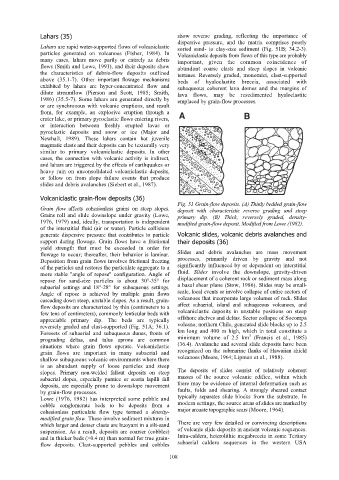
                                                               Fig. 51 Grain-flow deposits. (A) Thinly bedded grain-flow
               Grain flow  affects  cohesionless grains on  steep slopes.   deposit with characteristic reverse grading and steep
               Grains roll  and  slide downslope under gravity  (Lowe,   primary  dip. (B) Thick,  reversely graded, density-
               1976, 1979) and, ideally, transportation is independent   modified grain-flow deposit. Modified from Lowe (1982).
               of the interstitial fluid (air or water). Particle collisions
               generate dispersive pressure  that contributes to particle   Volcanic slides, volcanic debris avalanches and
               support during flowage. Grain  flows  have  a  frictional   their deposits (36)
               yield strength that must be exceeded  in  order  for
               flowage to occur; thereafter, their behavior  is  laminar.   Slides and debris avalanches are mass  movement
               Deposition from grain flows involves frictional freezing   processes,  primarily driven by  gravity and  not
               of the particles and restores the particulate aggregate to a   significantly influenced by or dependent on interstitial
               more stable "angle  of repose" configuration. Angle of   fluid.  Slides  involve  the downslope, gravity-driven
               repose for sand-size particles  is  about 30°-35° for   displacement of a coherent rock or sediment mass along
               subaerial  settings and 18°-28° for subaqueous settings.   a basal shear plane (Stow, 1986). Slides may be small-
               Angle of repose  is achieved by  multiple  grain flows   scale, local events or involve collapse of entire sectors of
               cascading down steep, unstable slopes. As a result, grain-  volcanoes that incorporate large volumes of rock. Slides
               flow deposits are characterized by thin (centimeters to a   affect subaerial, island and subaqueous volcanoes, and
               few tens of centimeters), commonly lenticular beds with   volcaniclastic  deposits in unstable  positions on steep
               appreciable primary dip.  The  beds  are  typically   offshore shelves and deltas. Sector collapse of Socompa
               reversely graded and clast-supported (Fig. 51A; 36.1).   volcano, northern Chile, generated slide blocks up to 2.5
               Foresets  of subaerial and  subaqueous  dunes,  fronts  of   km  long and  400 m  high,  which in total constitute  a
                                                                                        3
               prograding  deltas, and talus aprons are  common   minimum  volume of 2.5 km  (Francis et al., 1985)
               situations  where  grain flows operate. Volcaniclastic   (36.4). Avalanche and several slide deposits have been
               grain  flows  are important in many subaerial  and   recognized on the submarine flanks of Hawaiian shield
               shallow subaqueous volcanic environments where there   volcanoes (Moore, 1964; Lipman et al., 1988).
               is an  abundant supply of loose particles  and steep
               slopes.  Primary non-welded fallout  deposits on steep   The deposits  of slides  consist of relatively coherent
               subaerial  slopes,  especially pumice or scoria lapilli fall   masses  of the source  volcanic  edifice, within which
               deposits, are especially prone  to  downslope  movement   there may be evidence of internal deformation such as
               by grain-flow processes.                        faults,  folds  and  shearing. A strongly sheared contact
               Lowe (1976, 1982) has interpreted some pebble and   typically  separates  slide  blocks  from the substrate. In
               cobble conglomerate beds to be deposits from  a   modern settings, the source areas of slides are marked by
               cohesionless  particulate flow type  termed a  density-  major arcuate topographic scars (Moore, 1964).
               modified grain flow. These involve sediment mixtures in
               which larger and denser clasts are buoyant in a silt-sand   There are very few detailed or convincing descriptions
               suspension. As a result, deposits are coarser (cobbles)   of volcanic slide deposits in ancient volcanic sequences.
               and in thicker beds (>0.4 m) than normal for true grain-  Intra-caldera, heterolithic megabreccia in some Tertiary
               flow  deposits. Clast-supported pebbles  and  cobbles   subaerial  caldera sequences in the  western  USA
                                                            108

