


Page 127 - Volcanic Textures A Guide To The Interpretation of Textures In Volcanic Rocks
P. 127
considered to be a good indicator of relatively shallow- Crowe and Fisher, 1973; Lorenz, 1973; Cole, 1991)
water (above storm-wave-base), storm-affected shelf occur near vent, and planar bedded deposits dominate at
settings. distal sites (Wohletz and Sheridan, 1979). Sets of surge
sandwave beds can be separated by laterally continuous,
Pyroclastic surges and their deposits (38) even, thin, fine ash layers that commonly contain
accretionary lapilli (co-surge fallout ash ─ Walker,
Pyroclastic surges are ground-hugging, dilute (low 1984). Near vent, base surge deposits may be disturbed
particle:gas ratio), particulate flows in which pyroclasts by impact craters from ballistic bombs and blocks, and
are carried laterally, entrained in turbulent gas (Fisher, there is a general decrease in grain size and thickness of
1979; Walker, 1981c). Pyroclastic surges are generated deposits with distance from source. Evidence for
directly from explosive phreatomagmatic and phreatic dampness of pyroclasts during emplacement is common
eruptions (base surges), and in association with the (e.g. accretionary lapilli, vesiculated ash, ash-coated
eruption and emplacement of pyroclastic flows (ash lapilli — Lorenz, 1974; adhesion to steeply inclined
cloud surges and ground surges). The passage of a surfaces ─ Moore, 1967). Juvenile pyroclasts may show
pyroclastic surge results in deposition of a set of very the hallmarks of interaction with water during
thin beds or laminae, collectively termed a bed-set. fragmentation, and be blocky and poorly vesiculated.
Base surges occur at both inundated vents and vents that
are saturated with ground water (Moore, 1967; Fisher
and Waters, 1970; Crowe and Fisher, 1973; Waters and
Fisher, 1971; Wohletz and Sheridan, 1979). They are
most commonly associated with small basaltic volcanic
centers, but more silicic magmas are known to have
generated base surges (e.g. Schmincke et al., 1973;
Sheridan and Updike, 1975). Ground surges are
pyroclastic surges that precede emplacement of
pyroclastic flows (Sparks et al., 1973). Moving
pyroclastic flows are invariably associated with
overriding, dilute, turbulent ash clouds that may become
detached and flow independently, as ash cloud surges
(Fisher, 1979; Fisher and Heiken, 1982; Fisher et al.,
1980). Ground surges and ash cloud surges are mainly
associated with dacitic or rhyolitic, pumiceous
pyroclastic flows and block and ash flows.
Characteristics
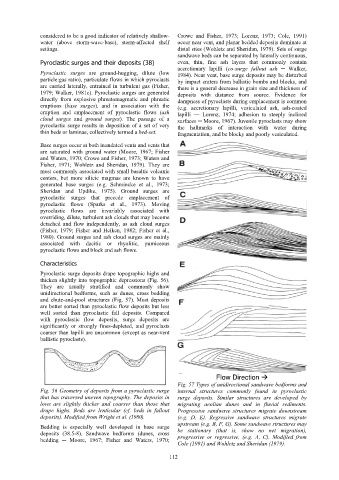
Pyroclastic surge deposits drape topographic highs and
thicken slightly into topographic depressions (Fig. 56).
They are usually stratified and commonly show
unidirectional bedforms, such as dunes, cross bedding
and chute-and-pool structures (Fig. 57). Most deposits
are better sorted than pyroclastic flow deposits but less
well sorted than pyroclastic fall deposits. Compared
with pyroclastic flow deposits, surge deposits are
significantly or strongly fines-depleted, and pyroclasts
coarser than lapilli are uncommon (except as near-vent
ballistic pyroclasts).
Flow Direction
Fig. 57 Types of unidirectional sandwave bedforms and
Fig. 56 Geometry of deposits from a pyroclastic surge internal structures commonly found in pyroclastic
that has traversed uneven topography. The deposits in surge deposits. Similar structures are developed by
lows are slightly thicker and coarser than those that migrating aeolian dunes and in fluvial sediments.
drape highs. Beds are lenticular (cf. beds in fallout Progressive sandwave structures migrate downstream
deposits). Modified from Wright et al. (1980). (e.g. D, E). Regressive sandwave structures migrate
upstream (e.g. B, F, G). Some sandwave structures may
Bedding is especially well developed in base surge
deposits (38.5-8). Sandwave bedforms (dunes, cross be stationary (that is, show no net migration),
progressive or regressive, (e.g. A, C). Modified from
bedding ─ Moore, 1967; Fisher and Waters, 1970;
Cole (1991) and Wohletz and Sheridan (1979).
112

