


Page 129 - Volcanic Textures A Guide To The Interpretation of Textures In Volcanic Rocks
P. 129
atmosphere are temporarily  suspended, but eventually   commonly present in ash grain size fall deposits (39.6).
               fall back down and accumulate to form pyroclastic fall   Juvenile  pyroclasts are typically ragged  or irregularly
               deposits. Large, dense pyroclasts follow  ballistic   shaped. Sorting  of  particles according to density and
               trajectories unaffected by  wind, and fall  close to the   size has the effect of producing layers that are
               vent. Small, light pyroclasts entrained into the eruption   dominated by one particular pyroclast type, such as
               column and plume are deposited further from the vent,   pumice or scoria lapilli, crystals, or glass shards.
               the distance depending on their terminal fall velocity,
               the lateral expansion  of the  plume and  wind velocity
               (Walker et al., 1971;  Walker, 1973a; Wilson, 1972;
               Carey and Sparks, 1986;  Wilson and Walker, 1987;
               Wilson et al., 1987).

               Clouds  of (ash) pyroclasts are also  generated  by
               elutriation from moving pyroclastic flows (Sparks et al.,
               1973; Walker, 1981b; Sparks and Walker, 1977; Sparks
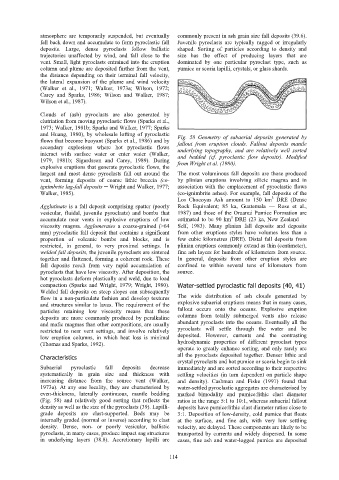
               and Huang, 1980),  by wholesale lofting  of pyroclastic   Fig.  58  Geometry of subaerial deposits generated  by
               flows that become buoyant (Sparks et al., 1986) and by   fallout from eruption clouds. Fallout  deposits mantle
               secondary explosions where hot pyroclastic flows   underlying topography, and  are relatively well sorted
               interact with surface water  or enter  water (Walker,   and  bedded (cf. pyroclastic flow deposits). Modified
               1979,  1981b; Sigurdsson and Carey,  1989).  During   from Wright et al. (1980).
               explosive eruptions that generate pyroclastic flows, the
               largest and most  dense pyroclasts fall  out around the   The most voluminous fall deposits are those produced
               vent, forming deposits of  coarse lithic  breccia  (co-  by plinian eruptions involving silicic  magma and in
               ignimbrite lag-fall deposits ─ Wright and Walker, 1977;   association  with the emplacement of pyroclastic flows
               Walker, 1985).                                  (co-ignimbrite ashes). For example, fall deposits of the
                                                                                                3
                                                               Los Chocoyas Ash amount to 150 km  DRE (Dense
               Agglutinate is a fall deposit comprising spatter (poorly   Rock Equivalent; 85 ka, Guatemala —  Rose et al.,
               vesicular, fluidal, juvenile  pyroclasts) and bombs that   1987) and those of the Oruanui Pumice Formation are
                                                                                  3
               accumulate near vents in explosive eruptions  of low   estimated to be 90 km  DRE (23 ka, New Zealand —
               viscosity magma.  Agglomerates  a coarse-grained (>64   Self, 1983).  Many plinian fall deposits and  deposits
               mm) pyroclastic fall deposit that contains a significant   from other eruptions  styles have volumes less than a
               proportion of volcanic  bombs and  blocks, and is   few cubic kilometres (DRE). Distal fall deposits  from
               restricted, in  general, to very proximal settings. In   plinian eruptions commonly extend as thin (centimeter),
               welded fall deposits, the juvenile pyroclasts are sintered   fine ash layers for hundreds of kilometers from source.
               together and flattened, forming a coherent rock. These   In  general,  deposits from  other eruption styles are
               fall deposits  result from very rapid accumulation  of   confined to  within several tens  of  kilometers from
               pyroclasts that have low viscosity. After deposition, the   source.
               hot pyroclasts deform plastically and weld, due to load
               compaction  (Sparks  and Wright, 1979; Wright, 1980).   Water-settled pyroclastic fall deposits (40, 41)
               Welded fall deposits on steep slopes can subsequently
               flow in a  non-particulate fashion and  develop textures   The wide  distribution of  ash  clouds generated by
               and structures similar to lavas. The requirement of the   explosive subaerial eruptions means that in many cases,
               particles retaining low  viscosity  means that these   fallout occurs onto the  oceans. Explosive eruption
               deposits are more commonly produced by peralkaline   columns from totally submerged vents also release
               and mafic magmas than other compositions, are usually   abundant pyroclasts into the oceans. Eventually all the
               restricted to near vent settings, and involve relatively   pyroclasts will settle through the  water and be
               low eruption  columns, in which heat loss is  minimal   deposited. However, currents and the contrasting
               (Thomas and Sparks, 1992).                      hydrodynamic properties of different pyroclast types
                                                               operate to greatly enhance sorting, and only rarely are
               Characteristics                                 all the pyroclasts deposited together. Denser lithic and
                                                               crystal pyroclasts and hot pumice or scoria begin to sink
               Subaerial  pyroclastic  fall  deposits  decrease  immediately and are sorted according to their respective
               systematically in grain size and thickness with   settling velocities (in turn dependent on particle shape
               increasing distance from the source vent (Walker,   and  density).  Cashman and Fiske (1991) found that
               1973a).  At any one locality, they are characterised  by   water-settled pyroclastic aggregates are characterised by
               even-thickness, laterally continuous, mantle bedding   marked bimodality and  pumice:lithic clast diameter
               (Fig. 58) and relatively good sorting that reflects the   ratios in the range 5:1 to 10:1, whereas subaerial fallout
               density as well as the size of the pyroclasts (39). Lapilli-  deposits have pumice:lithic clast diameter ratios close to
               grade  deposits are clast-supported. Beds may be   3:1. Deposition of low-density, cold pumice that floats
               internally graded (normal or inverse) according to clast   at the surface, and fine ash,  with  very  low settling
               density. Dense, non- or  poorly vesicular,  ballistic   velocity, are delayed. These components are likely to be
               pyroclasts, in many cases, produce impact sag structures   transported by currents and widely dispersed. In some
               in underlying layers (38.8). Accretionary lapilli are   cases, fine ash and water-logged pumice are deposited

                                                            114

