


Page 133 - Volcanic Textures A Guide To The Interpretation of Textures In Volcanic Rocks
P. 133
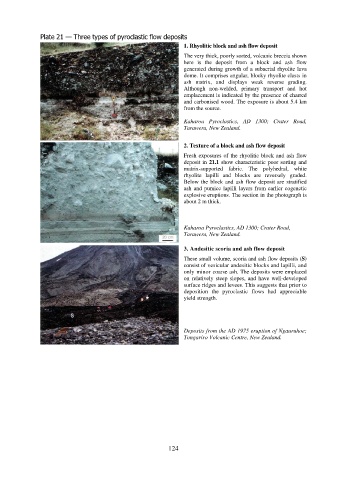
Plate 21 — Three types of pyroclastic flow deposits
                                                                  1. Rhyolitic block and ash flow deposit

                                                                  The very thick, poorly sorted, volcanic breccia shown
                                                                  here is the deposit from a block and ash flow
                                                                  generated during growth of a subaerial rhyolite lava
                                                                  dome. It comprises angular, blocky rhyolite clasts in
                                                                  ash matrix, and  displays weak  reverse grading.
                                                                  Although non-welded,  primary transport and  hot
                                                                  emplacement is indicated by the presence of charred
                                                                  and carbonised wood. The exposure is about 5.4 km
                                                                  from the source.

                                                                  Kaharoa Pyroclastics, AD 1300; Crater Road,
                                                                  Tarawera, New Zealand.

                                                                  2. Texture of a block and ash flow deposit
                                                                  Fresh exposures of the rhyolitic block and ash flow
                                                                  deposit in 21.1 show characteristic poor sorting and
                                                                  matrix-supported fabric. The polyhedral, white
                                                                  rhyolite lapilli and  blocks are reversely graded.
                                                                  Below the  block and ash  flow  deposit are  stratified
                                                                  ash and pumice lapilli layers from earlier cogenetic
                                                                  explosive eruptions. The section in the photograph is
                                                                  about 2 m thick.


                                                                  Kaharoa Pyroclastics, AD 1300; Crater Road,
                                                                  Tarawera, New Zealand.

                                                                  3. Andesitic scoria and ash flow deposit
                                                                  These small volume, scoria and ash flow deposits (S)
                                                                  consist of vesicular andesitic blocks and lapilli, and
                                                                  only minor coarse ash. The deposits were emplaced
                                                                  on  relatively steep slopes, and  have  well-developed
                                                                  surface ridges and levees. This suggests that prior to
                                                                  deposition the pyroclastic  flows  had appreciable
                                                                  yield strength.


                                                                  Deposits from the AD 1975 eruption of Ngauruhoe;
                                                                  Tongariro Volcanic Centre, New Zealand.


                                                            124

