


Page 136 - Volcanic Textures A Guide To The Interpretation of Textures In Volcanic Rocks
P. 136
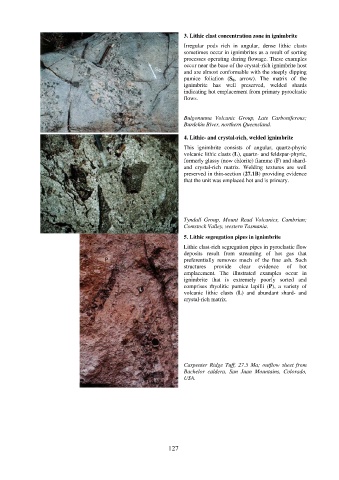
3. Lithic clast concentration zone in ignimbrite
                                                                  Irregular pods rich in angular, dense lithic clasts
                                                                  sometimes occur in ignimbrites as a result of sorting
                                                                  processes operating during flowage. These examples
                                                                  occur near the base of the crystal-rich ignimbrite host
                                                                  and are almost conformable with the steeply dipping
                                                                  pumice foliation (S 0, arrow). The matrix of the
                                                                  ignimbrite has well preserved,  welded shards
                                                                  indicating hot emplacement from primary pyroclastic
                                                                  flows.


                                                                  Bulgonunna Volcanic Group, Late Carboniferous;
                                                                  Burdekin River, northern Queensland.

                                                                  4. Lithic- and crystal-rich, welded ignimbrite
                                                                  This ignimbrite consists of angular,  quartz-phyric
                                                                  volcanic lithic clasts (L), quartz- and feldspar-phyric,
                                                                  formerly glassy (now chlorite) fiamme (F) and shard-
                                                                  and crystal-rich matrix.  Welding textures  are well
                                                                  preserved in thin-section (27.1B) providing evidence
                                                                  that the unit was emplaced hot and is primary.


                                                                  Tyndall Group, Mount Read Volcanics, Cambrian;
                                                                  Comstock Valley, western Tasmania.
                                                                  5. Lithic segregation pipes in ignimbrite
                                                                  Lithic clast-rich segregation pipes in pyroclastic flow
                                                                  deposits result from streaming of  hot gas that
                                                                  preferentially removes much of the fine ash. Such
                                                                  structures  provide  clear  evidence  of  hot
                                                                  emplacement. The illustrated examples occur in
                                                                  ignimbrite that is extremely poorly sorted and
                                                                  comprises rhyolitic pumice  lapilli (P), a  variety of
                                                                  volcanic lithic clasts (L) and abundant shard- and
                                                                  crystal-rich matrix.


                                                                  Carpenter Ridge Tuff, 27.5  Ma;  outflow sheet from
                                                                  Bachelor caldera,  San Juan Mountains,  Colorado,
                                                                  USA.


                                                            127

