


Page 139 - Volcanic Textures A Guide To The Interpretation of Textures In Volcanic Rocks
P. 139
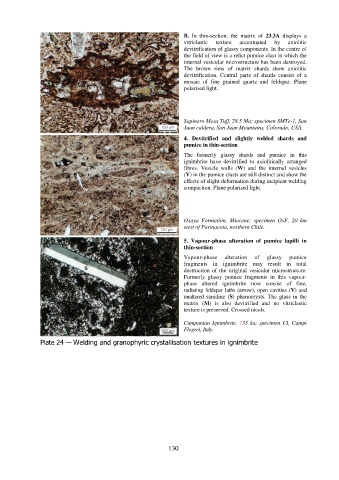
B. In thin-section, the matrix of  23.3A displays a
                                                                  vitriclastic  texture  accentuated  by  axiolitic
                                                                  devitrification of glassy components. In the centre of
                                                                  the field of view is a relict pumice clast in which the
                                                                  internal vesicular microstructure has been destroyed.
                                                                  The brown rims of matrix shards show axiolitic
                                                                  devitrification. Central parts of shards consist of  a
                                                                  mosaic of fine grained quartz and feldspar. Plane
                                                                  polarised light.


                                                                  Sapinero Mesa Tuff, 28.5 Ma; specimen SMTe-1, San
                                                                  Juan caldera, San Juan Mountains, Colorado, USA.

                                                                  4. Devitrified and slightly welded shards and
                                                                  pumice in thin-section
                                                                  The  formerly glassy shards and  pumice in this
                                                                  ignimbrite have devitrified to axiolitically arranged
                                                                  fibres. Vesicle  walls (W) and the internal vesicles
                                                                  (V) in the pumice clasts are still distinct and show the
                                                                  effects of slight deformation during incipient welding
                                                                  compaction. Plane polarised light.


                                                                  Oxaya Formation, Miocene; specimen OxF, 20 km
                                                                  west of Parinacota, northern Chile.

                                                                  5. Vapour-phase  alteration of  pumice lapilli in
                                                                  thin-section
                                                                  Vapour-phase  alteration  of  glassy  pumice
                                                                  fragments  in  ignimbrite  may result in total
                                                                  destruction of  the original vesicular microstructure.
                                                                  Formerly glassy pumice fragments in  this  vapour-
                                                                  phase  altered ignimbrite now consist of fine,
                                                                  radiating feldspar laths (arrow), open cavities (V) and
                                                                  unaltered sanidine  (S)  phenocrysts. The glass in the
                                                                  matrix (M) is also devitrified and  no  vitriclastic
                                                                  texture is preserved. Crossed nicols.

                                                                  Campanian Ignimbrite,  ?33 ka; specimen CI, Campi
                                                                  Flegrei, Italy.

               Plate 24 — Welding and granophyric crystallisation textures in ignimbrite


                                                            130

