


Page 137 - Volcanic Textures A Guide To The Interpretation of Textures In Volcanic Rocks
P. 137
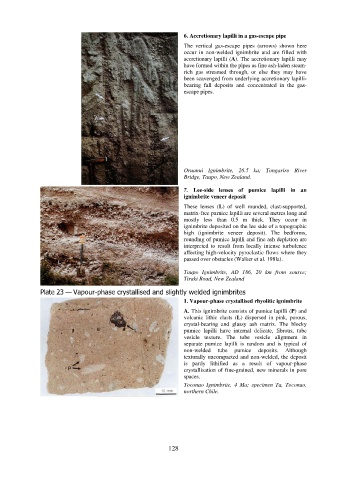
6. Accretionary lapilli in a gas-escape pipe
                                                                  The vertical gas-escape pipes (arrows) shown  here
                                                                  occur in  non-welded ignimbrite and are  filled with
                                                                  accretionary lapilli (A). The accretionary lapilli may
                                                                  have formed within the pipes as fine ash-laden steam-
                                                                  rich gas streamed through,  or else they  may have
                                                                  been scavenged from underlying accretionary lapilli-
                                                                  bearing  fall deposits and concentrated in the  gas-
                                                                  escape pipes.


                                                                  Oruanui  Ignimbrite,  26.5 ka; Tongariro River
                                                                  Bridge, Taupo, New Zealand.

                                                                  7.  Lee-side lenses of pumice lapilli in an
                                                                  ignimbrite veneer deposit
                                                                  These lenses  (L) of well rounded, clast-supported,
                                                                  matrix-free purnice lapilli are several metres long and
                                                                  mostly less than  0.5 m  thick. They occur in
                                                                  ignimbrite deposited on the lee side of a topographic
                                                                  high (ignimbrite veneer  deposit). The  bedforms,
                                                                  rounding of pumice lapilli and fine ash depletion are
                                                                  interpreted to result from locally intense turbulence
                                                                  affecting high-velocity pyroclastic flows where they
                                                                  passed over obstacles (Walker et al. 198la).

                                                                  Taupo  Ignimbrite, AD  186, 20 km from source;
                                                                  Tiraki Road, New Zealand

               Plate 23 — Vapour-phase crystallised and slightly welded ignimbrites
                                                                  1. Vapour-phase crystallised rhyolitic ignimbrite
                                                                  A. This ignimbrite consists of pumice lapilli (P) and
                                                                  volcanic lithic clasts (L)  dispersed in pink, porous,
                                                                  crystal-bearing and  glassy ash matrix. The blocky
                                                                  pumice lapilli have internal delicate,  fibrous, tube
                                                                  vesicle texture. The tube vesicle alignment in
                                                                  separate  pumice lapilli is random and is typical of
                                                                  non-welded  tube pumice deposits.  Although
                                                                  texturally uncompacted and non-welded, the deposit
                                                                  is partly lithified as a result of vapour-phase
                                                                  crystallisation of fine-grained, new minerals in pore
                                                                  spaces.
                                                                  Toconao  Ignimbrite, 4 Ma;  specimen Ta,  Toconao,
                                                                   northern Chile.


                                                            128

