


Page 135 - Volcanic Textures A Guide To The Interpretation of Textures In Volcanic Rocks
P. 135
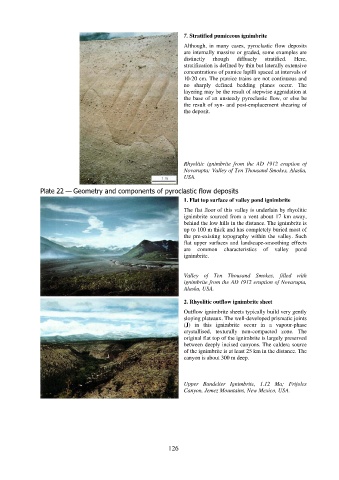
7. Stratified pumiceous ignimbrite
                                                                  Although, in  many cases,  pyroclastic flow  deposits
                                                                  are internally massive or graded, some examples are
                                                                  distinctly  rhough  diffusely  stratified.  Here,
                                                                  stratification is defined by thin but laterally extensive
                                                                  concentrations of pumice lapilli spaced at intervals of
                                                                  10-20 cm. The pumice trains are not continuous and
                                                                  no sharply defined bedding planes occur. The
                                                                  layering may be the result of stepwise aggradation at
                                                                  the base of an unsteady pyroclastic flow, or else be
                                                                  the result of syn- and post-emplacement shearing of
                                                                  the deposit.


                                                                  Rhyolitic ignimbrite from the AD  1912 eruption  of
                                                                  Novarupta; Valley of Ten Thousand Smokes, Alaska,
                                                                  USA.

               Plate 22 — Geometry and components of pyroclastic flow deposits
                                                                  1. Flat top surface of valley pond ignimbrite
                                                                  The flat floor of this valley is underlain by rhyolitic
                                                                  ignimbrite sourced from a vent about 17  km away,
                                                                  behind the low hills in the distance. The ignimbrite is
                                                                  up to 100 m thick and has completely buried most of
                                                                  the pre-existing topography  within the  valley. Such
                                                                  flat upper surfaces and landscape-smoothing effects
                                                                  are common characteristics of  valley pond
                                                                  ignimbrite.


                                                                  Valley of Ten Thousand Smokes, filled with
                                                                  ignimbrite from the AD 1912 eruption of Novarupta,
                                                                  Alaska, USA.

                                                                  2. Rhyolitic outflow ignimbrite sheet

                                                                  Outflow ignimbrite sheets typically build very gently
                                                                  sloping plateaux. The well-developed prismatic joints
                                                                  (J) in this ignimbrite occur in a vapour-phase
                                                                  crystallised, texturally non-compacted zone. The
                                                                  original flat top of the ignimbrite is largely preserved
                                                                  between deeply incised canyons. The caldera source
                                                                  of the ignimbrite is at least 25 km in the distance. The
                                                                  canyon is about 300 m deep.


                                                                  Upper Bandelier Ignimbrite, 1.12 Ma;  Frijoles
                                                                  Canyon, Jemez Mountains, New Mexico, USA.


                                                            126

