


Page 134 - Volcanic Textures A Guide To The Interpretation of Textures In Volcanic Rocks
P. 134
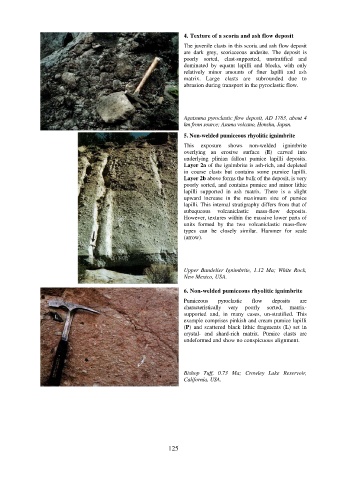
4. Texture of a scoria and ash flow deposit
                                                                  The juvenile clasts in this scoria and ash flow deposit
                                                                  are dark grey, scoriaceous andesite. The deposit is
                                                                  poorly sorted, clast-supported,  unstratified  and
                                                                  dominated  by equant lapilli and blocks,  with  only
                                                                  relatively  minor amounts of finer lapilli and ash
                                                                  matrix. Large clasts are subrounded due to
                                                                  abrasion during transport in the pyroclastic flow.


                                                                  Agatsuma pyroclastic flow deposit, AD 1783, about 4
                                                                  km from source; Asama volcano, Honshu, Japan.

                                                                  5. Non-welded pumiceous rhyolitic ignimbrite
                                                                  This exposure shows  non-welded  ignimbrite
                                                                  overlying an erosive surface (E) carved into
                                                                  underlying  plinian fallout  pumice lapilli deposits.
                                                                  Layer 2a of the ignimbrite is ash-rich, and depleted
                                                                  in coarse clasts but contains some pumice lapilli.
                                                                  Layer 2b above forms the bulk of the deposit, is very
                                                                  poorly sorted, and contains pumice and minor lithic
                                                                  lapilli supported in ash matrix. There is a slight
                                                                  upward increase in the maximum size of pumice
                                                                  lapilli. This internal stratigraphy differs from that of
                                                                  subaqueous volcaniclastic  mass-flow  deposits.
                                                                  However, textures within the massive lower parts of
                                                                  units formed by the two volcaniclastic mass-flow
                                                                  types can be closely similar.  Hammer for scale
                                                                  (arrow).


                                                                  Upper Bandelier Ignimbrite, 1.12 Ma; White Rock,
                                                                  New Mexico, USA.

                                                                  6. Non-welded pumiceous rhyolitic ignimbrite
                                                                  Pumiceous   pyroclastic  flow  deposits  are
                                                                  characteristically very poorly  sorted,  matrix-
                                                                  supported and, in many cases,  un-stratified.  This
                                                                  example comprises pinkish and cream pumice lapilli
                                                                  (P) and scattered black lithic fragments (L) set  in
                                                                  crystal- and shard-rich  matrix. Pumice clasts are
                                                                  undeformed and show no conspicuous alignment.


                                                                  Bishop Tuff, 0.73 Ma; Crowley Lake Reservoir,
                                                                  California, USA.


                                                            125

