


Page 131 - Volcanic Textures A Guide To The Interpretation of Textures In Volcanic Rocks
P. 131
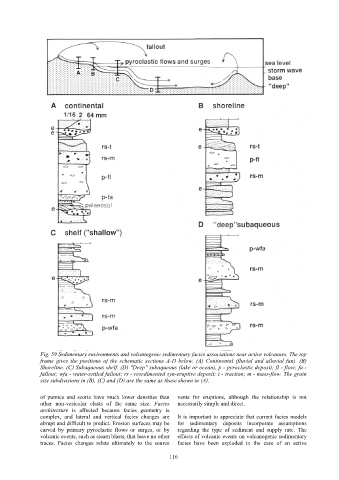
Fig. 59 Sedimentary environments and volcanogenic sedimentary facies associations near active volcanoes. The top
               frame  gives the  positions  of the schematic sections A-D  below. (A) Continental (fluvial  and  alluvial fan). (B)
               Shoreline. (C) Subaqueous shelf. (D) "Deep" subaqueous (lake or ocean), p - pyroclastic deposit; fl - flow; fa -
               fallout; wfa - water-settled fallout; rs - resedimented syn-eruptive deposit: t - traction; m - mass-flow. The grain
               size subdivisions in (B), (C) and (D) are the same as those shown in (A).

               of  pumice and scoria  have  much lower  densities than   vents  for eruptions, although the relationship is not
               other non-vesicular clasts of the same size.  Facies   necessarily simple and direct.
               architecture  is affected because facies  geometry is
               complex, and lateral and  vertical facies changes are   It is important to appreciate that current facies models
               abrupt and difficult to predict. Erosion surfaces may be   for sedimentary deposits incorporate assumptions
               carved by primary pyroclastic flows or surges,  or by   regarding the type of sediment and supply rate. The
               volcanic events, such as steam blasts, that leave no other   effects of volcanic events on volcanogenic sedimentary
               traces.  Facies changes relate ultimately to the source   facies have  been exploded in the case  of an active

                                                            116

