


Page 126 - Volcanic Textures A Guide To The Interpretation of Textures In Volcanic Rocks
P. 126
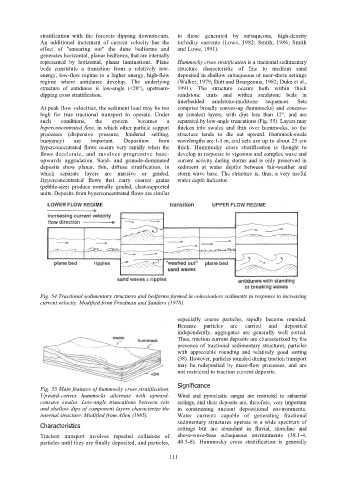
stratification  with the foresets dipping downstream.   to those  generated by  subaqueous, high-density
               An  additional  increment  of current  velocity has the   turbidity currents (Lowe, 1982; Smith, 1986; Smith
               effect of  "smearing out"  the dune bedforms  and   and Lowe, 1991).
               generates horizontal, planar bedforms, that are internally
               represented by horizontal, planar laminations.  Plane   Hummocky cross stratification is a tractional sedimentary
               beds constitute a transition from a relatively  low-  structure characteristic of fine to medium sand
               energy, low-flow regime to  a higher energy, high-flow   deposited in shallow subaqueous or near-shore settings
               regime where antidunes  develop. The underlying   (Walker, 1979; Dott and Bourgeouis, 1982; Duke et al.,
               structure of antidunes  is  low-angle (<20°), upstream-  1991).  The structure occurs both within  thick
               dipping cross stratification.                   sandstone units  and within sandstone  beds  in
                                                               interbedded  sandstone-mudstone  sequences.  Sets
               At peak flow velocities, the sediment load may be too   comprise broadly  convex-up (hummocks)  and concave-
               high for true tractional transport to operate.  Under   up (swales)  layers, with dips less  than 12°, and are
               such   conditions,  the  system   becomes    a  separated by low-angle truncations (Fig. 55). Layers may
               hyperconcentrated flow, in which other particle support   thicken  into  swales and thin  over  hummocks, so the
               processes (dispersive pressure,  hindered settling,   structure tends to die  out  upward.  Hummock-swale
               buoyancy)   are   important.  Deposition  from  wavelengths are 1-5 m, and sets are up to about 25 cm
               hyperconcentrated flows occurs very rapidly when  the   thick. Hummocky cross stratification  is  thought  to
               flows  decelerate, and involves progressive base-  develop in response to vigorous and complex wave and
               upwards  aggradation. Sand- and  granule-dominated   current activity during storms and is only preserved in
               deposits  show  planar, thin, diffuse  stratification, in   sediment  at water depths between fair-weather and
               which separate layers are massive or graded.    storm wave base. The structure is, thus, a very  useful
               Hyperconcentrated flows that carry coarser  grains   water depth indicator.
               (pebble-size) produce normally graded, clast-supported
               units. Deposits from hyperconcentrated flows are similar


               Fig. 54 Tractional sedimentary structures and bedforms formed in cohesionless sediments in response to increasing
               current velocity. Modified from Friedman and Sanders (1978).

                                                               especially  coarse particles, rapidly become rounded.
                                                               Because   particles  are  carried  and  deposited
                                                               independently, aggregates are generally well sorted.
                                                               Thus, traction current deposits are characterized by the
                                                               presence of  tractional sedimentary  structures, particles
                                                               with appreciable rounding and relatively  good  sorting
                                                               (38). However, particles rounded during traction transport
                                                               may be redeposited  by mass-flow  processes, and are
                                                               not restricted to traction current deposits.

                                                               Significance
               Fig. 55 Main features of hummocky cross stratification.
               Upward-convex hummocks alternate with upward-   Wind and  pyroclastic surges are  restricted to subaerial
               concave swales. Low-angle truncations between  sets   settings, and their deposits are, therefore, very important
               and shallow dips of component layers characterize the   in  constraining ancient depositional environments.
               internal structure. Modified from Allen (1985).   Water currents capable  of  generating fractional
                                                               sedimentary structures operate in a wide spectrum of
               Characteristics
                                                               settings  but  are abundant in fluvial,  shoreline  and
               Traction transport involves repeated collisions  of   above-wave-base subaqueous environments  (38.1-4,
               particles until they are finally deposited, and particles,   40.5-8).  Hummocky cross stratification is generally

                                                            111

