


Page 121 - Volcanic Textures A Guide To The Interpretation of Textures In Volcanic Rocks
P. 121
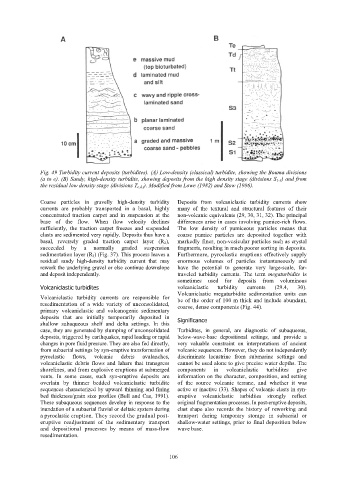
Fig. 49 Turbidity current deposits (turbidites). (A) Low-density (classical) turbidite, showing the Bouma divisions
               (a to e). (B) Sandy, high-density turbidite, showing deposits from the high density stage (divisions S 1-3) and from
               the residual low density stage (divisions T e,d,t). Modified from Lowe (1982) and Stow (1986).

               Coarse particles in gravelly high-density turbidity   Deposits from volcaniclastic turbidity currents show
               currents  are probably transported in a basal, highly   many  of the textural and structural features of their
               concentrated  traction carpet and in suspension at the   non-volcanic equivalents (29, 30, 31, 32). The principal
               base  of the flow.  When  flow  velocity  declines   differences arise in cases involving pumice-rich flows.
               sufficiently,  the traction carpet freezes  and  suspended   The low density of pumiceous  particles  means that
               clasts are sedimented very rapidly. Deposits thus have a   coarse  pumice particles are deposited  together  with
               basal, reversely graded traction carpet  layer  (R 2),   markedly finer, non-vesicular particles such as crystal
               succeeded by a normally graded suspension       fragments, resulting in much poorer sorting in deposits.
               sedimentation layer (R 3) (Fig. 37). This process leaves a   Furthermore, pyroclastic eruptions  effectively  supply
               residual sandy high-density  turbidity current  that  may   enormous  volumes of particles instantaneously  and
               rework the underlying gravel or else continue downslope   have the  potential to generate very large-scale, far-
               and deposit independently.                      traveled turbidity currents. The term  megaturbidite  is
                                                               sometimes used for  deposits from voluminous
               Volcaniclastic turbidites                       volcaniclastic  turbidity  currents  (29.4,  30).
                                                               Volcaniclastic  megaturbidite sedimentation  units can
               Volcaniclastic turbidity currents are  responsible for   be of the order of 100 m thick and include abundant,
               resedimentation of  a wide variety  of  unconsolidated,   coarse, dense components (Fig. 44).
               primary  volcaniclastic and volcanogenic sedimentary
               deposits that are initially temporarily  deposited in   Significance
               shallow subaqueous shelf and delta settings.  In this
               case, they are generated by slumping of unconsolidated   Turbidites, in general, are diagnostic of  subaqueous,
               deposits, triggered by earthquakes, rapid loading or rapid   below-wave-base depositional settings,  and provide a
               changes in pore fluid pressure. They are also fed directly,   very  valuable constraint on  interpretations of ancient
               from subaerial settings by syn-eruptive transformation of   volcanic sequences. However, they do not independently
               pyroclastic  flows,  volcanic  debris  avalanches,  discriminate  lacustrine  from submarine settings and
               volcaniclastic  debris  flows and lahars that transgress   cannot be used alone to give precise water depths. The
               shorelines, and from explosive eruptions at submerged   components  in  volcaniclastic  turbidites  give
               vents. In some cases, such syn-eruptive  deposits  are   information on the character, composition, and setting
               overlain by  thinner bedded volcaniclastic  turbidite   of the  source volcanic terrane,  and  whether it  was
               sequences characterized by upward thinning and fining   active or inactive (33). Shapes of volcanic clasts in syn-
               bed thickness/grain size profiles (Bull and Cas, 1991).   eruptive  volcaniclastic turbidites strongly reflect
               These subaqueous sequences develop in response to the   original fragmentation processes. In post-eruptive deposits,
               inundation of a subaerial fluvial or deltaic system during   clast  shape  also records the  history  of reworking and
               a pyroclastic eruption. They record the gradual post-  transport during  temporary  storage in  subaerial or
               eruptive  readjustment of the  sedimentary  transport   shallow-water settings, prior to final deposition below
               and depositional processes  by means  of  mass-flow   wave base.
               resedimentation.


                                                            106

