


Page 119 - Volcanic Textures A Guide To The Interpretation of Textures In Volcanic Rocks
P. 119
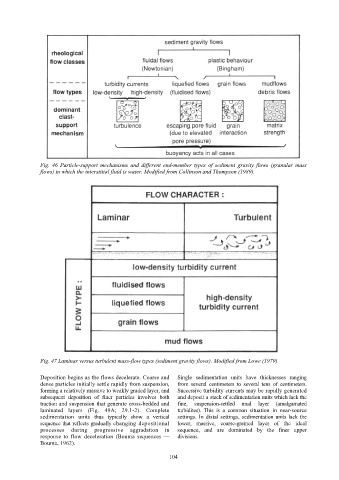
Fig. 46  Particle-support mechanisms  and different  end-member types  of sediment  gravity flows (granular mass
               flows) in which the interstitial fluid is water. Modified from Collinson and Thompson (1989).


               Fig. 47 Laminar versus turbulent mass-flow types (sediment gravity flows). Modified from Lowe (1979).

               Deposition begins as the flows decelerate. Coarse and   Single sedimentation units have thicknesses ranging
               dense particles initially settle rapidly from suspension,   from  several centimeters  to several  tens of  centimeters.
               forming a relatively massive to weakly graded layer, and   Successive turbidity currents may be rapidly generated
               subsequent deposition of finer particles  involves both   and deposit a stack of sedimentation units which lack the
               traction and suspension that generate cross-bedded and   fine,  suspension-settled mud layer (amalgamated
               laminated  layers (Fig.  49A; 29.1-2). Complete   turbidites). This is a common situation  in  near-source
               sedimentation  units  thus  typically show a vertical   settings. In distal settings, sedimentation units lack the
               sequence that reflects gradually changing depositional   lower,  massive, coarse-grained layer of  the  ideal
               processes during progressive  aggradation  in   sequence, and are  dominated by the finer  upper
               response to flow deceleration (Bouma sequences  —   divisions.
               Bouma, 1962).

                                                            104

