


Page 124 - Volcanic Textures A Guide To The Interpretation of Textures In Volcanic Rocks
P. 124
(Lipman, 1976) probably include deposits from true   Two distinct facies are typically present within volcanic
               slides.  The  paucity  of  examples is a reflection of the   debris-avalanche deposits:  block facies  consists of
               difficulty of recognizing these deposits, rather than their   relatively  intact pieces (debris avalanche blocks) of the
               abundance. Slide blocks in ancient sequences are likely   source volcano, whereas  mixed facies  consists of an
               to be misinterpreted as faulted parts of otherwise in situ   unsorted,  unstratified,  thorough blend of all  the rock
               and intact volcanic stratigraphy.               types  present  in the source (Glicken, 1991). Debris
                                                               avalanche blocks can be gigantic and usually measure at
               Slides are commonly associated with debris avalanches,   least several  metres  to tens of metres across  (36.5-6).
               rapid, gravity-driven flows of unsorted mixtures of rock   Blocks  up to 500 m across  occur in the  Nirasaki
               and sediment (Ui, 1983; Siebert, 1984; Siebert et al.,   avalanche deposit  of Yatsugatake volcano,  Japan  (Ui,
               1987). Water or ice may be present within and between   1983). Block size commonly decreases with distance of
               debris avalanche blocks but they do not contribute to   outflow from the source. Blocks dislodged at the time
               particle  support or  transportation. Deposition occurs   of  failure  are  fractured  as  a result of dilation and
               en  masse by  frictional  freezing. Volcanic debris   shattered  during transport  (Glicken, 1991). Blocks
               avalanches commonly evolve from slides initiated by   that comprise weaker  lithologies  disintegrate  rapidly
               sector collapse and may be synchronous with explosive   and contribute to mixed facies in the deposit, whereas
               eruptions, the best known recent example being that of   stronger  lithologies  survive and form  the block facies
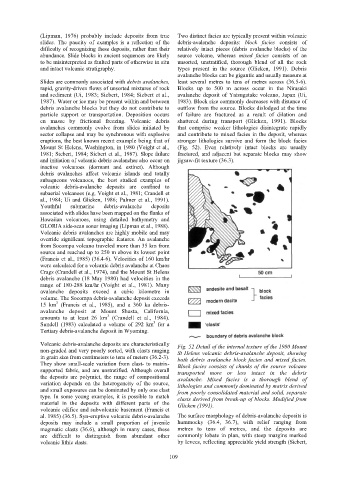
               Mount St Helens, Washington, in 1980 (Voight et al.,   (Fig. 52). Even relatively  intact blocks  are usually
               1981; Siebert, 1984; Siebert et al., 1987). Slope failure   fractured, and adjacent but separate blocks  may  show
               and initiation of volcanic debris avalanches also occur on   jigsaw-fit texture (36.3).
               inactive volcanoes (dormant and extinct). Although
               debris avalanches affect  volcanic islands  and totally
               subaqueous  volcanoes, the  best studied examples of
               volcanic  debris-avalanche deposits are confined to
               subaerial volcanoes (e.g. Voight et al., 1981; Crandell et
               al., 1984; Ui and Glicken,  1986; Palmer et al., 1991).
               Youthful   submarine  debris-avalanche  deposits
               associated with slides have been mapped on the flanks of
               Hawaiian volcanoes,  using detailed  bathymetry and
               GLORIA side-scan sonar imaging (Lipman et al., 1988).
               Volcanic debris avalanches are highly mobile and may
               override significant topographic features. An avalanche
               from Socompa volcano traveled more than 35 km from
               source and reached up to 250 m above its lowest point
               (Francis et al., 1985) (36.4-6). Velocities of 160 km/hr
               were calculated for a volcanic debris avalanche at Chaos
               Crags (Crandell et al., 1974), and the Mount St Helens
               debris avalanche (18 May 1980) had velocities in the

               range of 180-288 km/hr (Voight et  al., 1981).  Many
               avalanche deposits exceed  a  cubic  kilometre  in
               volume. The Socompa debris-avalanche deposit exceeds
                     3
               15 km  (Francis et al.,  1985), and a  360 ka  debris-
               avalanche deposit at  Mount Shasta,  California,
                                       3
               amounts  to at  least 26 km  (Crandell  et al.,  1984).
                                                       3
               Sundell  (1983) calculated a  volume of 292 km  for a
               Tertiary debris-avalanche deposit in Wyoming.

               Volcanic debris-avalanche deposits are characteristically   Fig. 52 Detail of the internal texture of the 1980 Mount
               non-graded and very poorly sorted, with clasts ranging   St Helens volcanic debris-avalanche deposit, showing
               in grain size from centimeters to tens of meters (36.2-3).   both debris avalanche block facies  and  mixed facies.
               They show small-scale variation from clast- to matrix-  Block facies consists of chunks of the source volcano
               supported  fabric, and are unstratified. Although overall   transported  more  or less intact in the  debris
               the deposits  are polymict,  the  range  of  compositional   avalanche. Mixed facies is a thorough  blend  of
               variation depends on  the heterogeneity of the source,   lithologies and commonly dominated by matrix derived
               and small exposures can be dominated by only one clast   from poorly consolidated material and solid, separate
               type. In some  young examples, it  is possible to  match   clasts derived from break-up of blocks. Modified from
               material in the deposits with different  parts  of  the   Glicken (1991).
               volcanic edifice and subvolcanic basement (Francis et
               al. 1985) (36.5). Syn-eruptive volcanic debris-avalanche   The surface morphology of debris-avalanche deposits is
               deposits  may  include a small proportion of juvenile   hummocky (36.4,  36.7),  with relief ranging from
               magmatic clasts (36.6), although in many cases, these   metres  to  tens  of metres, and the  deposits are
               are difficult  to distinguish from  abundant other   commonly lobate in plan, with steep margins marked
               volcanic lithic clasts.                         by levees, reflecting appreciable yield strength (Siebert,

                                                            109

