


Page 125 - Volcanic Textures A Guide To The Interpretation of Textures In Volcanic Rocks
P. 125
1984). In any one deposit, some of the hummocks consist   currents of volcanic gas and steam that are produced by
               of block facies, either a small  number  of  blocks  all  of   explosive eruptions and transport pyroclasts largely by
               one  lithology  or groups  of blocks of different   traction.
               lithologies, and other hummocks consist of only mixed
               facies or combinations of mixed facies and debris
               avalanche blocks (Glicken,  1991). Deposit thicknesses
               range from several metres to more than 100 m. Volcanic
               debris  avalanches  that include or  incorporate  large
               volumes of  water or snow or ice may transform
               laterally into debris flows, and deposits from the two
               flow types are commonly closely associated.

               Massive    sulfide  clast-bearing  submarine
               volcaniclastic mass-flow deposits (37)
               The importance of studies  of the clast  populations in
               mass-flow  deposits is clearly demonstrated by cases
               where clasts derived from massive sulfide deposits are
               included.  These are  not uncommon in submarine
               volcaniclastic  mass-flow  deposits  in host sequences to
               massive sulfide mineralization, such as the Mount Read
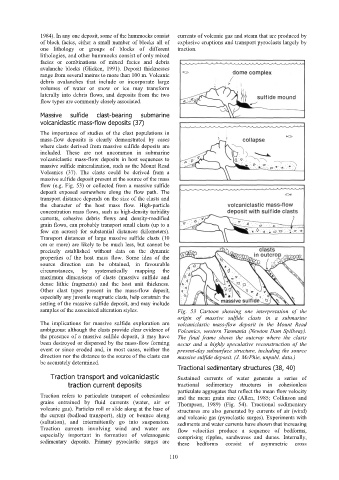
               Volcanics (37). The clasts could  be derived from a
               massive sulfide deposit present at the source of the mass
               flow (e.g. Fig. 53) or collected from a  massive sulfide
               deposit exposed somewhere  along the flow path. The
               transport distance depends on the size of the clasts and
               the  character of the host  mass flow. High-particle
               concentration mass flows, such as high-density turbidity
               currents,  cohesive  debris flows and density-modified
               grain flows, can probably transport small clasts (up to a
               few cm across) for substantial distances (kilometers).
               Transport distances of large  massive sulfide clasts (10
               cm or  more) are likely to be  much less, but cannot be
               precisely established without data on the dynamic
               properties  of  the host mass flow. Some  idea of the
               source  direction can be obtained, in favourable
               circumstances,  by  systematically  mapping  the
               maximum dimensions  of clasts (massive  sulfide and
               dense  lithic fragments)  and  the host unit thickness.
               Other  clast types  present  in the mass-flow deposit,
               especially any juvenile magmatic clasts, help constrain the
               setting of the massive sulfide deposit, and may include
               samples of the associated alteration styles.    Fig. 53 Cartoon showing  one interpretation  of the
                                                               origin of massive sulfide clasts in  a submarine
               The implications  for massive sulfide exploration are   volcaniclastic  mass-flow  deposit in the Mount Read
               ambiguous: although the clasts provide clear evidence of   Volcanics, western Tasmania (Newton Dam Spillway).
               the presence of a massive sulfide deposit, it may have   The final frame shows the outcrop where the clasts
               been destroyed or dispersed by the mass-flow forming   occur and a  highly speculative  reconstruction of  the
               event or since eroded and, in most cases, neither the   present-day subsurface structure, including the source
               direction nor the distance to the source of the clasts can   massive sulfide deposit. (J. McPhie, unpubl. data.)
               be accurately determined.
                                                               Tractional sedimentary structures (38, 40)
                   Traction transport and volcaniclastic       Sustained  currents of water generate a  series of
                         traction current deposits             tractional  sedimentary structures in cohesionless
                                                               particulate aggregates that reflect the mean flow velocity
               Traction refers to particulate transport of  cohesionless   and the mean grain size  (Allen,  1985;  Collinson  and
               grains  entrained  by  fluid currents (water, air  or   Thompson, 1989) (Fig. 54).  Tractional sedimentary
               volcanic gas). Particles roll or slide along at the base of   structures are also generated by currents of air (wind)
               the  current  (bedload  transport), skip or bounce along   and volcanic gas (pyroclastic surges). Experiments with
               (saltation), and intermittently  go  into  suspension.   sediments and water currents have shown that increasing
               Traction  currents  involving  wind and water are   flow velocities produce a sequence of bedforms,
               especially  important in formation of volcanogenic   comprising ripples, sandwaves and dunes. Internally,
               sedimentary deposits. Primary pyroclastic  surges are   these  bedforms  consist  of  asymmetric  cross

                                                            110

