


Page 120 - Volcanic Textures A Guide To The Interpretation of Textures In Volcanic Rocks
P. 120
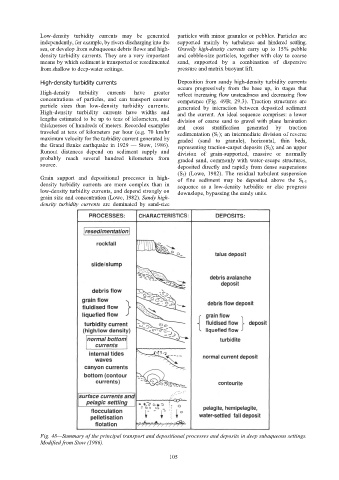
Low-density  turbidity currents may be generated   particles with minor granules or  pebbles. Particles  are
               independently, for example, by rivers discharging into the   supported mainly  by turbulence  and  hindered  settling.
               sea, or develop from subaqueous debris flows and high-  Gravelly high-density currents  carry  up to 15%  pebble
               density turbidity currents. They are a very important   and cobble-size particles, together with clay to coarse
               means by which sediment is transported or resedimented   sand,  supported by a  combination of  dispersive
               from shallow to deep-water settings.            pressure and matrix buoyant lift.

               High-density turbidity currents                 Deposition from sandy high-density turbidity currents
                                                               occurs progressively from the  base up, in stages that
               High-density  turbidity  currents  have  greater  reflect  increasing flow unsteadiness and  decreasing flow
               concentrations of  particles,  and can transport coarser   competence  (Fig. 49B; 29.3). Traction structures  are
               particle sizes than low-density  turbidity  currents.   generated  by  interaction between deposited sediment
               High-density turbidity currents  have  widths  and   and the current. An ideal  sequence  comprises:  a lower
               lengths estimated to  be up to tens of  kilometers,  and   division of coarse sand to gravel  with  plane  lamination
               thicknesses of hundreds of meters. Recorded examples   and  cross  stratification  generated  by  traction
               traveled at tens of  kilometers per  hour  (e.g. 70  km/hr   sedimentation (S 1); an intermediate division of reverse
               maximum velocity for the turbidity current generated by   graded (sand to granule), horizontal, thin beds,
               the Grand Banks earthquake in 1929 — Stow, 1986).   representing traction-carpet deposits (S 2); and an upper
               Runout distances depend on sediment  supply and   division of  grain-supported, massive or normally
               probably reach  several hundred kilometers  from   graded  sand, commonly with water-escape  structures,
               source.                                         deposited directly and rapidly from dense suspensions
                                                               (S 3) (Lowe, 1982).  The residual  turbulent  suspension
               Grain support and  depositional  processes in high-  of  fine  sediment  may be deposited above the S 1-3
               density turbidity currents are more complex than in   sequence as a low-density turbidite  or  else  progress
               low-density turbidity currents, and depend strongly on   downslope, bypassing the sandy units.
               grain size and concentration (Lowe, 1982). Sandy high-
               density turbidity currents  are dominated by sand-size


               Fig. 48—Summary of the principal transport and depositional processes and deposits in deep subaqueous settings.
               Modified from Stow (1986).

                                                            105

