


Page 140 - Volcanic Textures A Guide To The Interpretation of Textures In Volcanic Rocks
P. 140
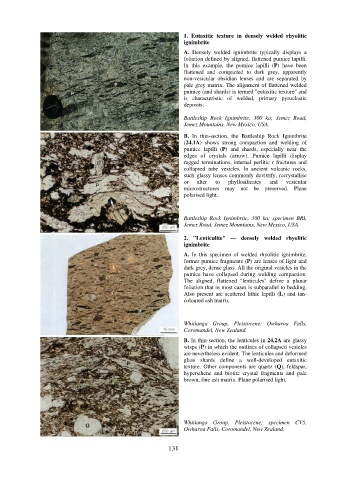
1.  Eutaxitic  texture in densely welded rhyolitic
                                                                  ignimbrite
                                                                  A.  Densely welded ignimbrite typically displays  a
                                                                  foliation defined by aligned, flattened pumice lapilli.
                                                                  In this example, the  pumice lapilli (P) have been
                                                                  flattened and  compacted to dark grey, apparently
                                                                  non-vesicular  obsidian lenses and are separated by
                                                                  pale grey matrix. The alignment of flattened welded
                                                                  pumice (and shards) is termed "eutaxitic texture" and
                                                                  is characteristic of  welded, primary pyroclastic
                                                                  deposits.

                                                                  Battleship Rock Ignimbrite, 300 ka; Jemez Road,
                                                                  Jemez Mountains, New Mexico, USA.

                                                                  B. In thin-section, the Battleship Rock  Ignimbrite
                                                                  (24.1A) shows strong compaction and  welding  of
                                                                  pumice lapilli (P) and shards, especially near the
                                                                  edges of crystals (arrow).  Pumice  lapilli display
                                                                  ragged terminations, internal perlitic r  fractures and
                                                                  collapsed tube vesicles. In  ancient volcanic rocks,
                                                                  such glassy lenses commonly devitrify, recrystallise
                                                                  or  alter  to  phyllosilicates  and  vesicular
                                                                  microstructures  may not be preserved. Plane
                                                                  polarised light.


                                                                  Battleship Rock Ignimbrite, 300 ka; specimen BRI,
                                                                  Jemez Road, Jemez Mountains, New Mexico, USA.

                                                                  2. "Lenticulite" —  densely welded rhyolitic
                                                                  ignimbrite
                                                                  A.  In this specimen of  welded rhyolitic ignimbrite,
                                                                  former pumice fragments (P) are lenses of light and
                                                                  dark grey, dense glass. All the original vesicles in the
                                                                  pumice have  collapsed during welding compaction.
                                                                  The aligned,  flattened "lenticules" define a planar
                                                                  foliation that in most cases is subparallel to bedding.
                                                                  Also  present are scattered lithic lapilli (L) and  tan-
                                                                  coloured ash matrix.


                                                                  Whitianga  Group, Pleistocene; Owharoa Falls,
                                                                   Coromandel, New Zealand.
                                                                  B. In thin-section, the lenticules in 24.2A are glassy
                                                                  wisps (P) in which the outlines of collapsed vesicles
                                                                  are nevertheless evident. The lenticules and deformed
                                                                  glass shards define a  well-developed eutaxitic
                                                                  texture. Other components are quartz (Q), feldspar,
                                                                  hypersthene and  biotite crystal fragments and pale
                                                                  brown, fine ash matrix. Plane polarised light.


                                                                  Whitianga Group, Pleistocene; specimen CV5,
                                                                  Owharoa Falls, Coromandel, New Zealand.


                                                            131

