


Page 145 - Volcanic Textures A Guide To The Interpretation of Textures In Volcanic Rocks
P. 145
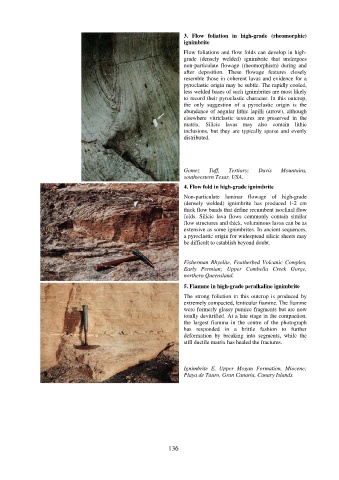
3.  Flow foliation in high-grade (rheomorphic)
                                                                  ignimbrite
                                                                  Flow foliations and flow folds can develop in high-
                                                                  grade  (densely welded) ignimbrite that undergoes
                                                                  non-particulate flowage (rheomorphism) during and
                                                                  after  deposition. These flowage  features closely
                                                                  resemble those in coherent lavas and evidence for a
                                                                  pyroclastic origin may be subtle. The rapidly cooled,
                                                                  less welded bases of such ignimbrites are most likely
                                                                  to record their pyroclastic character. In this outcrop,
                                                                  the only suggestion  of a  pyroclastic origin is the
                                                                  abundance of angular lithic lapilli (arrow), although
                                                                  elsewhere vitriclastic  textures are preserved in the
                                                                  matrix. Silicic lavas  may also contain lithic
                                                                  inclusions,  but they are typically sparse and evenly
                                                                  distributed.


                                                                  Gomez   Tuff,  Tertiary;  Davis   Mountains,
                                                                   southwestern Texas, USA.
                                                                  4. Flow fold in high-grade ignimbrite
                                                                  Non-particulate laminar flowage  of  high-grade
                                                                  (densely  welded) ignimbrite has produced 1-2 cm
                                                                  thick flow bands that define recumbent isoclinal flow
                                                                  folds. Silicic lava flows commonly contain similar
                                                                  flow structures and thick, voluminous lavas can be as
                                                                  extensive as some ignimbrites. In ancient sequences,
                                                                  a pyroclastic origin for widespread silicic sheets may
                                                                  be difficult to establish beyond doubt.


                                                                  Fisherman Rhyolite, Featherbed Volcanic Complex,
                                                                  Early Permian;  Upper Combella Creek Gorge,
                                                                  northern Queensland.

                                                                  5. Fiamme in high-grade peralkaline ignimbrite
                                                                  The strong foliation in this  outcrop is produced  by
                                                                  extremely compacted, lenticular fiamme. The fiamme
                                                                  were formerly glassy pumice fragments but are now
                                                                  totally devitrified. At a late stage in the compaction,
                                                                  the largest  fiamma in the centre  of the  photograph
                                                                  has  responded in a  brittle fashion to  further
                                                                  deformation by breaking into segments, while the
                                                                  still ductile matrix has healed the fractures.


                                                                  Ignimbrite E, Upper Mogan Formation, Miocene;
                                                                  Playa de Tauro, Gran Canaria, Canary Islands.


                                                            136

