


Page 147 - Volcanic Textures A Guide To The Interpretation of Textures In Volcanic Rocks
P. 147
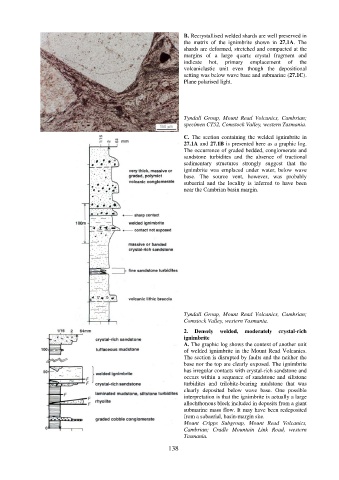
B. Recrystallised welded shards are well preserved in
                                                                  the matrix of  the ignimbrite shown in  27.1A. The
                                                                  shards are deformed, stretched and compacted at the
                                                                  margins  of a large quartz crystal fragment and
                                                                  indicate  hot,  primary  emplacement  of  the
                                                                  volcaniclastic unit even though the  depositional
                                                                  setting was below wave base and submarine (27.1C).
                                                                  Plane polarised light.


                                                                  Tyndall Group, Mount Read Volcanics, Cambrian;
                                                                  specimen CT52, Comstock Valley, western Tasmania.

                                                                  C. The section containing the welded ignimbrite in
                                                                  27.1A and 27.1B is presented here as a graphic log.
                                                                  The occurrence of graded bedded, conglomerate and
                                                                  sandstone turbidites and the absence  of tractional
                                                                  sedimentary structures  strongly suggest that the
                                                                  ignimbrite was emplaced under water, below  wave
                                                                  base. The  source vent, however, was  probably
                                                                  subaerial and  the locality  is inferred to have been
                                                                  near the Cambrian basin margin.


                                                                  Tyndall Group, Mount Read Volcanics, Cambrian;
                                                                   Comstock Valley, western Tasmania.
                                                                  2.  Densely welded, moderately  crystal-rich
                                                                  ignimbrite
                                                                  A. The graphic log shows the context of another unit
                                                                  of welded ignimbrite in the Mount Read Volcanics.
                                                                  The section is disrupted by faults and the neither the
                                                                  base nor the top are clearly exposed. The ignimbrite
                                                                  has irregular contacts with crystal-rich sandstone and
                                                                  occurs within a sequence of sandstone and siltstone
                                                                  turbidites and trilobite-bearing mudstone  that was
                                                                  clearly deposited below  wave base.  One possible
                                                                  interpretation is that the ignimbrite is actually a large
                                                                  allochthonous block included in deposits from a giant
                                                                  submarine mass flow. It may have been redeposited
                                                                  from a subaerial, basin-margin site.
                                                                  Mount Cripps Subgroup,  Mount Read  Volcanics,
                                                                  Cambrian; Cradle Mountain Link Road, western
                                                                  Tasmania.
                                                            138

