


Page 151 - Volcanic Textures A Guide To The Interpretation of Textures In Volcanic Rocks
P. 151
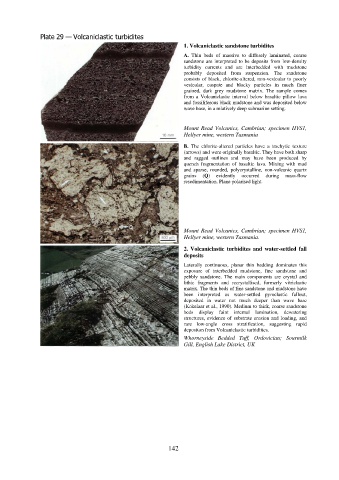
Plate 29 — Volcaniclastic turbidites
                                                                  1. Volcaniclastic sandstone turbidites

                                                                  A. Thin beds of massive to  diffusely laminated, coarse
                                                                  sandstone are interpreted to be deposits from low-density
                                                                  turbidity  currents and are interbedded with mudstone
                                                                  probably deposited from suspension. The  sandstone
                                                                  consists of black, chlorite-altered, non-vesicular to poorly
                                                                  vesicular, cuspate and blocky particles in  much finer
                                                                  grained, dark grey mudstone matrix. The sample comes
                                                                  from a Volcaniclastic interval  below basaltic  pillow lava
                                                                  and fossiliferous black mudstone and was deposited below
                                                                  wave base, in a relatively deep submarine setting.

                                                                  Mount Read Volcanics, Cambrian; specimen HVS1,
                                                                  Hellyer mine, western Tasmania

                                                                  B. The chlorite-altered particles have a trachytic  texture
                                                                  (arrows) and were originally basaltic. They have both sharp
                                                                  and ragged outlines and may have been produced  by
                                                                  quench fragmentation of basaltic lava. Mixing  with mud
                                                                  and sparse, rounded, polycrystalline, non-volcanic quartz
                                                                  grains (Q) evidently occurred during mass-flow
                                                                  resedimentation. Plane polarised light.


                                                                  Mount Read Volcanics, Cambrian; specimen HVS1,
                                                                  Hellyer mine, western Tasmania.

                                                                  2.  Volcaniclastic turbidites  and water-settled fall
                                                                  deposits
                                                                  Laterally  continuous, planar thin bedding dominates this
                                                                  exposure of interbedded mudstone, fine sandstone and
                                                                  pebbly sandstone. The main  components are crystal and
                                                                  lithic fragments and recrystallised, formerly  vitriclastic
                                                                  matrix. The thin beds of fine sandstone and mudstone have
                                                                  been interpreted as water-settled pyroclastic fallout,
                                                                  deposited in water not much deeper  than  wave base
                                                                  (Kokelaar et al., 1990). Medium to thick, coarse sandstone
                                                                  beds display faint internal lamination, dewatering
                                                                  structures, evidence of substrate erosion and loading, and
                                                                  rare  low-angle cross stratification, suggesting rapid
                                                                  depositon from Volcaniclastic turbidities.
                                                                  Whorneyside Bedded  Tuff, Ordovician; Sourmilk
                                                                  Gill, English Lake District, UK


                                                            142

