


Page 152 - Volcanic Textures A Guide To The Interpretation of Textures In Volcanic Rocks
P. 152
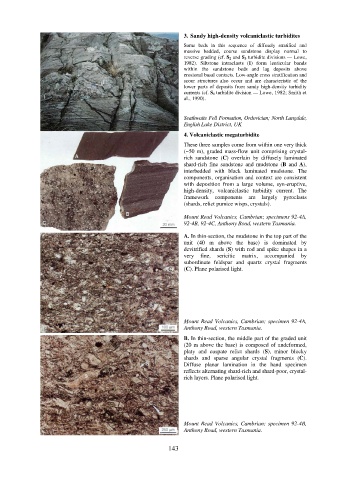
3.  Sandy high-density volcaniclastic turbidites
                                                                  Some beds in this sequence of diffusely stratified and
                                                                  massive  bedded, coarse sandstone display  normal to
                                                                  reverse grading (cf. S 2  and S 3  turbidite divisions — Lowe,
                                                                  1982). Siltstone intraclasts  (I) form lenticular bands
                                                                  within the  sandstone  beds  and lag deposits above
                                                                  erosional basal contacts. Low-angle cross stratification and
                                                                  scour structures also occur  and are characteristic of the
                                                                  lower parts of deposits from sandy high-density turbidity
                                                                  currents (cf. S 1  turbidite division — Lowe, 1982; Smith et
                                                                  al., 1990).


                                                                  Seathwaite Fell Formation, Ordovician; North Langdale,
                                                                  English Lake District, UK

                                                                  4. Volcaniclastic megaturbidite
                                                                  These three samples come from within one very thick
                                                                  (~50 m), graded mass-flow unit comprising crystal-
                                                                  rich sandstone (C) overlain by  diffusely  laminated
                                                                  shard-rich fine sandstone and mudstone (B and  A),
                                                                  interbedded  with black laminated mudstone. The
                                                                  components, organisation and context are consistent
                                                                  with deposition from a large volume, syn-eruptive,
                                                                  high-density, volcaniclastic turbidity current. The
                                                                  framework components are largely  pyroclasts
                                                                  (shards, relict pumice wisps, crystals).

                                                                  Mount Read Volcanics, Cambrian; specimens 92-4A,
                                                                  92-4B, 92-4C, Anthony Road, western Tasmania.

                                                                  A. In thin-section, the mudstone in the top part of the
                                                                  unit (40 m  above the  base) is dominated by
                                                                  devitrified shards (S) with rod and spike shapes in a
                                                                  very fine, sericitic  matrix,  accompanied by
                                                                  subordinate feldspar and  quartz crystal fragments
                                                                  (C). Plane polarised light.


                                                                  Mount Read Volcanics, Cambrian; specimen 92-4A,
                                                                   Anthony Road, western Tasmania.
                                                                  B. In thin-section, the middle part of the graded unit
                                                                  (20 m above the base) is composed of undeformed,
                                                                  platy and cuspate relict shards (S), minor  blocky
                                                                  shards and sparse angular crystal fragments (C).
                                                                  Diffuse  planar lamination in the hand  specimen
                                                                  reflects alternating shard-rich and shard-poor, crystal-
                                                                  rich layers. Plane polarised light.


                                                                  Mount Read Volcanics, Cambrian; specimen 92-4B,
                                                                  Anthony Road, western Tasmania.

                                                            143

