


Page 149 - Volcanic Textures A Guide To The Interpretation of Textures In Volcanic Rocks
P. 149
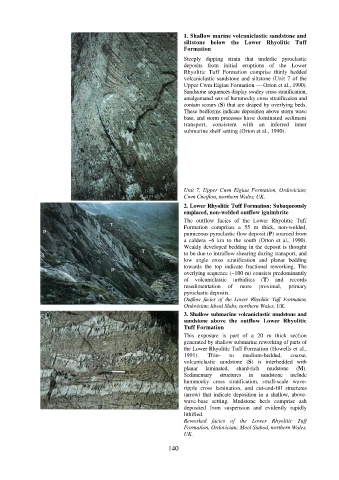
1. Shallow marine volcaniclastic sandstone and
                                                                  siltstone below the Lower Rhyolitic Tuff
                                                                  Formation
                                                                  Steeply dipping strata that underlie pyroclastic
                                                                  deposits  from  initial eruptions  of the Lower
                                                                  Rhyolitic Tuff Formation comprise  thinly  bedded
                                                                  volcaniclastic  sandstone and siltstone (Unit  7  of  the
                                                                  Upper Cwm Eigiau Formation — Orton et al., 1990).
                                                                  Sandstone sequences display swaley cross stratification,
                                                                  amalgamated sets of hummocky cross stratification and
                                                                  contain scours (S) that are draped by overlying beds.
                                                                  These bedforms indicate deposition above storm wave
                                                                  base, and storm processes have  dominated  sediment
                                                                  transport, consistent with an inferred  inner
                                                                  submarine shelf setting (Orton et al., 1990).


                                                                  Unit 7, Upper Cwm Eigiau  Formation, Ordovician;
                                                                  Cwm Cneifion, northern Wales, UK.
                                                                  2. Lower Rhyolitic Tuff Formation: Subaqueously
                                                                  emplaced, non-welded outflow ignimbrite
                                                                  The  outflow facies  of the Lower Rhyolitic Tuff
                                                                  Formation  comprises a 55  m thick, non-welded,
                                                                  pumiceous pyroclastic flow deposit (P) sourced from
                                                                  a  caldera ~6 km  to  the south (Orton  et  al.,  1990).
                                                                  Weakly developed bedding in the deposit is thought
                                                                  to be due to intraflow shearing during transport, and
                                                                  low angle cross stratification and  planar bedding
                                                                  towards the top indicate fractional reworking. The
                                                                  overlying sequence (~100 m) consists predominantly
                                                                  of volcaniclastic turbidites (T) and records
                                                                  resedimentation  of  more  proximal,  primary
                                                                  pyroclastic deposits.
                                                                  Outflow  facies of the Lower Rhyolitic Tuff Formation,

                                                                  Ordovician; Idwal Slabs, northern Wales, UK.
                                                                  3. Shallow submarine volcaniclastic mudstone and
                                                                  sandstone  above the outflow Lower  Rhyolitic
                                                                  Tuff Formation
                                                                  This exposure is part of  a 20 m thick section
                                                                  generated by shallow submarine reworking of parts of
                                                                  the Lower Rhyolitic Tuff Formation (Howells et al.,
                                                                  1991).  Thin-   to  medium-bedded,   coarse,
                                                                  volcaniclastic sandstone  (S) is interbedded with
                                                                  planar  laminated,  shard-rich  mudstone  (M).
                                                                  Sedimentary  structures  in  sandstone  include
                                                                  hummocky cross stratification, small-scale  wave-
                                                                  ripple cross lamination, and cut-and-fill structures
                                                                  (arrow) that  indicate deposition in  a shallow, above-
                                                                  wave-base setting. Mudstone beds comprise ash
                                                                  deposited  from suspension and evidently rapidly
                                                                  lithified.
                                                                  Reworked facies of the  Lower Rhyolitic Tuff
                                                                  Formation, Ordovician; Moel Siabod, northern Wales,
                                                                  UK.

                                                            140

