


Page 144 - Volcanic Textures A Guide To The Interpretation of Textures In Volcanic Rocks
P. 144
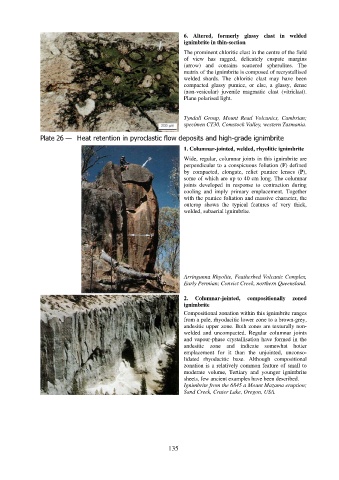
6.  Altered, formerly  glassy clast in welded
                                                                  ignimbrite in thin-section
                                                                  The prominent chloritic clast in the centre of the field
                                                                  of  view has ragged,  delicately cuspate margins
                                                                  (arrow) and  contains scattered spherulites.  The
                                                                  matrix of the ignimbrite is composed of recrystallised
                                                                  welded shards. The chloritic clast  may have been
                                                                  compacted glassy pumice, or else, a  glassy, dense
                                                                  (non-vesicular) juvenile magmatic clast (vitriclast).
                                                                  Plane polarised light.


                                                                  Tyndall Group, Mount Read Volcanics, Cambrian;
                                                                  specimen CT30, Comstock Valley, western Tasmania.

               Plate 26 —   Heat retention in pyroclastic flow deposits and high-grade ignimbrite
                                                                  1. Columnar-jointed, welded, rhyolitic ignimbrite
                                                                  Wide, regular, columnar joints in this ignimbrite are
                                                                  perpendicular to a conspicuous foliation (F) defined
                                                                  by compacted, elongate,  relict pumice lenses  (P),
                                                                  some of which are up to 40 cm long. The columnar
                                                                  joints developed in response to contraction  during
                                                                  cooling and imply  primary emplacement. Together
                                                                  with the pumice foliation and massive character, the
                                                                  outcrop shows the typical features of very thick,
                                                                  welded, subaerial ignimbrite.


                                                                  Arringunna Rhyolite, Featherbed Volcanic Complex,
                                                                  Early Permian; Convict Creek, northern Queensland.

                                                                  2.  Columnar-jointed, compositionally zoned
                                                                  ignimbrite
                                                                  Compositional zonation within this ignimbrite ranges
                                                                  from a pale, rhyodacitic lower zone to a brown-grey,
                                                                  andesitic upper zone. Both zones are texturally non-
                                                                  welded  and uncompacted. Regular columnar joints
                                                                  and vapour-phase crystallisation have formed in the
                                                                  andesitic zone and indicate somewhat hotter
                                                                  emplacement for it than the  unjointed, unconso-
                                                                  lidated rhyodacitic base. Although compositional
                                                                  zonation is a relatively common feature of small  to
                                                                  moderate volume, Tertiary and younger ignimbrite
                                                                  sheets, few ancient examples have been described.
                                                                  Ignimbrite from the 6845 a Mount Mazama eruption;
                                                                   Sand Creek, Crater Lake, Oregon, USA.


                                                            135

