


Page 143 - Volcanic Textures A Guide To The Interpretation of Textures In Volcanic Rocks
P. 143
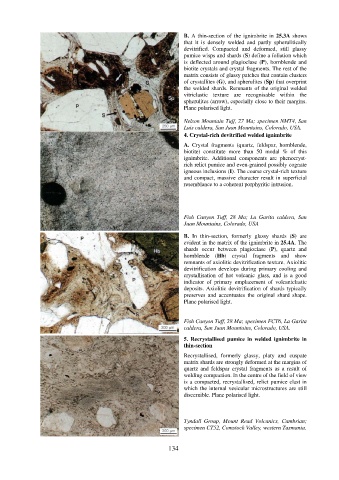
B. A thin-section of the ignimbrite in  25.3A shows
                                                                  that it is densely welded and partly spherulitically
                                                                  devitrified. Compacted and deformed, still glassy
                                                                  pumice wisps and shards (S) define a foliation which
                                                                  is deflected around plagioclase (P), hornblende  and
                                                                  biotite crystals and crystal fragments. The rest of the
                                                                  matrix consists of glassy patches that contain clusters
                                                                  of crystallites (G), and spherulites (Sp) that overprint
                                                                  the welded shards. Remnants of the original welded
                                                                  vitriclastic texture are  recognisable within the
                                                                  spherulites (arrow), especially close to their margins.
                                                                  Plane polarised light.

                                                                  Nelson Mountain Tuff, 27 Ma; specimen NMT4, San
                                                                  Luis caldera, San Juan Mountains, Colorado, USA.
                                                                  4. Crystal-rich devitrified welded ignimbrite
                                                                  A. Crystal fragments (quartz, feldspar, hornblende,
                                                                  biotite) constitute more than 50 modal % of this
                                                                  ignimbrite. Additional components are  phenocryst-
                                                                  rich relict pumice and even-grained possibly cognate
                                                                  igneous inclusions (I). The coarse crystal-rich texture
                                                                  and compact, massive character result in superficial
                                                                  resemblance to a coherent porphyritic intrusion.


                                                                  Fish  Canyon Tuff, 28  Ma; La Garita  caldera, San
                                                                  Juan Mountains, Colorado, USA

                                                                  B. In thin-section,  formerly glassy shards (S) are
                                                                  evident in the matrix of the ignimbrite in 25.4A. The
                                                                  shards  occur  between plagioclase (P), quartz  and
                                                                  hornblende (Hb) crystal fragments and show
                                                                  remnants of axiolitic devitrification texture. Axiolitic
                                                                  devitrification  develops during primary cooling and
                                                                  crystallisation of  hot volcanic glass, and is a good
                                                                  indicator  of primary emplacement of  volcaniclastic
                                                                  deposits. Axiolitic devitrification of shards typically
                                                                  preserves and accentuates the original shard shape.
                                                                  Plane polarised light.


                                                                  Fish Canyon Tuff, 28 Ma; specimen FCT6, La Garita
                                                                  caldera, San Juan Mountains, Colorado, USA.

                                                                  5.  Recrystallised pumice in welded ignimbrite in
                                                                  thin-section
                                                                  Recrystallised, formerly glassy, platy and cuspate
                                                                  matrix shards are strongly deformed at the margins of
                                                                  quartz and feldspar crystal fragments as a result of
                                                                  welding compaction. In the centre of the field of view
                                                                  is a compacted, recrystallised, relict pumice clast in
                                                                  which the internal vesicular microstructures are still
                                                                  discernible. Plane polarised light.


                                                                  Tyndall Group, Mount Read Volcanics, Cambrian;
                                                                  specimen CT52, Comstock Valley, western Tasmania.


                                                            134

