


Page 146 - Volcanic Textures A Guide To The Interpretation of Textures In Volcanic Rocks
P. 146
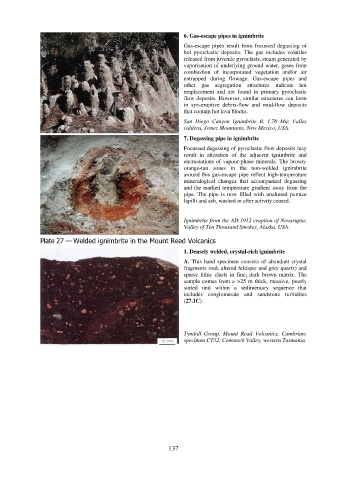
6. Gas-escape pipes in ignimbrite
                                                                  Gas-escape pipes result from focussed degassing of
                                                                  hot  pyroclastic deposits. The gas includes  volatiles
                                                                  released from juvenile pyroclasts, steam generated by
                                                                  vaporisation of underlying ground water, gases from
                                                                  combustion  of incorporated vegetation and/or air
                                                                  entrapped during flowage. Gas-escape  pipes  and
                                                                  other gas segregation structures indicate hot
                                                                  emplacement  and are found  in primary pyroclastic
                                                                  flow deposits. However, similar structures can form
                                                                  in syn-eruptive debris-flow  and mud-flow deposits
                                                                  that contain hot lava blocks.
                                                                  San Diego  Canyon Ignimbrite  B,  1.76 Ma; Valles
                                                                  caldera, Jemez Mountains, New Mexico, USA.

                                                                  7. Degassing pipe in ignimbrite
                                                                  Focussed degassing of pyroclastic flow deposits may
                                                                  result in alteration of the adjacent ignimbrite and
                                                                  encrustations of vapour-phase minerals. The brown-
                                                                  orange-tan zones in the  non-welded ignimbrite
                                                                  around this gas-escape pipe reflect high-temperature
                                                                  mineralogical changes  that accompanied degassing
                                                                  and the marked temperature gradient away from the
                                                                  pipe. The pipe is now filled with unaltered pumice
                                                                  lapilli and ash, washed in after activity ceased.


                                                                  Ignimbrite from the AD 1912 eruption of Novarupta;
                                                                  Valley of Ten Thousand Smokes, Alaska, USA.

               Plate 27 — Welded ignimbrite in the Mount Read Volcanics
                                                                  1. Densely welded, crystal-rich ignimbrite

                                                                  A. This hand specimen consists of abundant crystal
                                                                  fragments (red, altered feldspar and grey quartz) and
                                                                  sparse lithic clasts in fine,  dark brown matrix. The
                                                                  sample comes from a >25 m thick, massive, poorly
                                                                  sorted  unit within a sedimentary sequence that
                                                                  includes conglomerate and sandstone turbidites
                                                                  (27.1C).


                                                                  Tyndall Group, Mount Read Volcanics, Cambrian;
                                                                  specimen CT52, Comstock Valley, western Tasmania.


                                                            137

