


Page 150 - Volcanic Textures A Guide To The Interpretation of Textures In Volcanic Rocks
P. 150
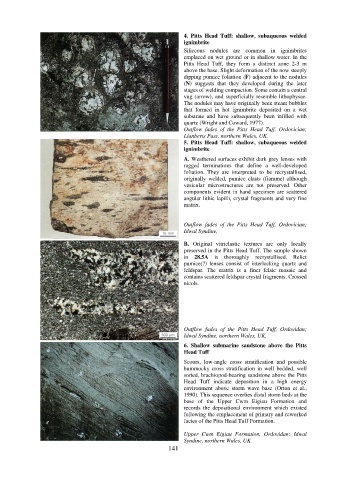
4.  Pitts Head  Tuff:  shallow, subaqueous welded
                                                                  ignimbrite
                                                                  Siliceous  nodules are common in ignimbrites
                                                                  emplaced on wet ground or in shallow water. In the
                                                                  Pitts Head Tuff, they form  a distinct zone 2-3  m
                                                                  above the base. Slight deformation of the now steeply
                                                                  dipping pumice foliation (F) adjacent to the nodules
                                                                  (N) suggests  that they developed  during the later
                                                                  stages of welding compaction. Some contain a central
                                                                  vug (arrow), and superficially resemble lithophysae.
                                                                  The nodules may have originally been steam bubbles
                                                                  that formed in hot ignimbrite deposited  on a wet
                                                                  substrate and  have subsequently been infilled with
                                                                  quartz (Wright and Coward, 1977).
                                                                  Outflow fades of the Pitts Head Tuff, Ordovician;
                                                                  Llanberis Pass, northern Wales, UK.
                                                                  5.  Pitts Head  Tuff:  shallow, subaqueous welded
                                                                  ignimbrite
                                                                  A. Weathered surfaces exhibit dark grey lenses with
                                                                  ragged terminations that define a well-developed
                                                                  foliation. They are interpreted to  be recrystallised,
                                                                  originally welded, pumice clasts (fiamme) although
                                                                  vesicular microstructures are not preserved. Other
                                                                  components evident in hand specimen are scattered
                                                                  angular lithic lapilli, crystal fragments and very fine
                                                                  matrix.


                                                                  Outflow fades of the Pitts Head Tuff, Ordovician;
                                                                  Idwal Syndine,

                                                                  B. Original  vitriclastic textures are  only locally
                                                                  preserved in the Pitts Head Tuff. The sample shown
                                                                  in  28.5A is thoroughly recrystallised. Relict
                                                                  pumice(?) lenses consist  of interlocking  quartz and
                                                                  feldspar. The matrix is a  finer felsic mosaic and
                                                                  contains scattered feldspar crystal fragments. Crossed
                                                                  nicols.


                                                                  Outflow fades of the Pitts  Head Tuff, Ordovidan;
                                                                   Idwal Syndine, northern Wales, UK.
                                                                  6.  Shallow submarine  sandstone above the  Pitts
                                                                  Head Tuff

                                                                  Scours, low-angle cross stratification and possible
                                                                  hummocky cross stratification in  well bedded,  well
                                                                  sorted, brachiopod-bearing sandstone above the Pitts
                                                                  Head Tuff indicate deposition in a high energy
                                                                  environment above storm wave  base (Orton  et al.,
                                                                  1990). This sequence overlies distal storm beds at the
                                                                  base  of the  Upper Cwm Eigiau  Formation and
                                                                  records the  depositional environment which existed
                                                                  following the emplacement of primary and reworked
                                                                  facies of the Pitts Head Tuff Formation.

                                                                  Upper Cwm  Eigiau Formation,  Ordovidan; Idwal
                                                                   Syndine, northern Wales, UK
                                                            141

