


Page 155 - Volcanic Textures A Guide To The Interpretation of Textures In Volcanic Rocks
P. 155
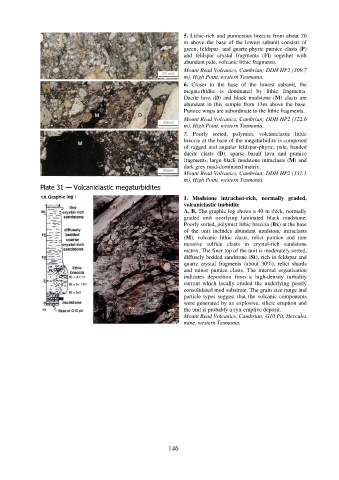
5. Lithic-rich and pumiceous breccia from about 26
                                                                  m above the  base of the lowest subunit consists  of
                                                                  green, feldspar- and quartz-phyric pumice clasts (P)
                                                                  and feldspar crystal  fragments  (Fl) together  with
                                                                  abundant pale, volcanic lithic fragments.
                                                                  Mount Read Volcanics, Cambrian; DDH HP2 (309.7
                                                                  m), High Point, western Tasmania.
                                                                  6. Closer to  the base  of the lowest subunit, the
                                                                  megaturbidite is dominated by lithic  fragments.
                                                                  Dacite lava (D) and black  mudstone (M) clasts are
                                                                  abundant in this sample from 13m above the  base.
                                                                  Pumice wisps are subordinate to the lithic fragments.
                                                                  Mount Read Volcanics, Cambrian; DDH HP2 (322.6
                                                                   m), High Point, western Tasmania.
                                                                  7.  Poorly sorted, polymict, volcaniclastic lithic
                                                                  breccia at the base of the megaturbidite is composed
                                                                  of ragged and angular feldspar-phyric, pale,  banded
                                                                  dacite clasts  (D), sparse  basalt lava and  pumice
                                                                  fragments, large black mudstone intraclasts (M) and
                                                                  dark grey mud-dominated matrix.
                                                                   Mount Read Volcanics, Cambrian; DDH HP2 (331.1
                                                                  m), High Point, western Tasmania.
               Plate 31 — Volcaniclastic megaturbidites

                                                                  1.  Mudstone intraclast-rich, normally  graded,
                                                                  volcaniclastic turbidite
                                                                  A, B. The graphic log shows a 40 m thick, normally
                                                                  graded unit overlying laminated  black  mudstone.
                                                                  Poorly sorted, polymict lithic breccia (Bx) at the base
                                                                  of the  unit includes abundant mudstone intraclasts
                                                                  (M), volcanic lithic clasts, relict pumice and rare
                                                                  massive sulfide clasts in crystal-rich sandstone
                                                                  matrix. The finer top of the unit is moderately sorted,
                                                                  diffusely bedded sandstone (St), rich in feldspar and
                                                                  quartz crystal fragments (about 30%),  relict shards
                                                                  and minor  pumice clasts. The internal organisation
                                                                  indicates  deposition from a high-density turbidity
                                                                  current  which locally eroded the underlying poorly
                                                                  consolidated mud substrate. The grain size range and
                                                                  particle types  suggest that the volcanic components
                                                                  were generated by an explosive, silicic eruption and
                                                                  the unit is probably a syn-eruptive deposit.
                                                                  Mount Read Volcanics, Cambrian; G10 Pit, Hercules
                                                                  mine, western Tasmania.


                                                            146

