


Page 159 - Volcanic Textures A Guide To The Interpretation of Textures In Volcanic Rocks
P. 159
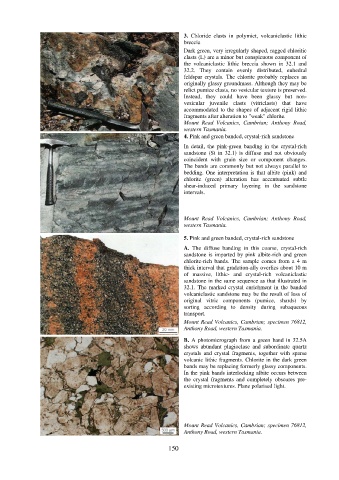
3. Chloride clasts in polymict, volcaniclastic lithic
                                                                  breccia
                                                                  Dark green, very irregularly shaped, ragged chloritic
                                                                  clasts (L) are a minor but conspicuous component of
                                                                  the volcaniclastic lithic breccia shown in 32.1 and
                                                                  32.2. They contain evenly distributed,  euhedral
                                                                  feldspar crystals. The chlorite probably replaces an
                                                                  originally glassy groundmass. Although they may be
                                                                  relict pumice clasts, no vesicular texture is preserved.
                                                                  Instead, they could have been glassy but non-
                                                                  vesicular juvenile  clasts (vitriclasts)  that have
                                                                  accommodated to the shapes of adjacent rigid lithic
                                                                  fragments after alteration to "weak" chlorite.
                                                                  Mount Read  Volcanics, Cambrian;  Anthony Road,
                                                                  western Tasmania.
                                                                  4. Pink and green banded, crystal-rich sandstone
                                                                  In  detail, the  pink-green  banding in the crystal-rich
                                                                  sandstone (St in  32.1)  is diffuse  and not obviously
                                                                  coincident  with grain size  or component changes.
                                                                  The bands are commonly but not always parallel to
                                                                  bedding. One interpretation is that albite (pink) and
                                                                  chlorite (green) alteration  has accentuated subtle
                                                                  shear-induced primary layering in the sandstone
                                                                  intervals.


                                                                  Mount Read  Volcanics, Cambrian;  Anthony Road,
                                                                  western Tasmania.

                                                                  5. Pink and green banded, crystal-rich sandstone
                                                                  A. The diffuse banding in this coarse, crystal-rich
                                                                  sandstone is imparted by pink albite-rich  and  green
                                                                  chlorite-rich bands. The sample comes from a 4  m
                                                                  thick interval that gradation-ally overlies about 10 m
                                                                  of massive, lithic- and crystal-rich  volcaniclastic
                                                                  sandstone in the same sequence as that illustrated in
                                                                  32.1. The marked crystal enrichment in the banded
                                                                  volcaniclastic sandstone may be the result of loss of
                                                                  original  vitric components (pumice, shards)  by
                                                                  sorting according to density during subaqueous
                                                                  transport.
                                                                  Mount Read Volcanics, Cambrian; specimen 76812,
                                                                  Anthony Road, western Tasmania.

                                                                  B.  A  photomicrograph from  a green band  in 32.5A
                                                                  shows abundant plagioclase and subordinate quartz
                                                                  crystals and crystal fragments, together with sparse
                                                                  volcanic lithic fragments. Chlorite in the dark green
                                                                  bands may be replacing formerly glassy components.
                                                                  In the pink bands interlocking albite occurs between
                                                                  the crystal fragments and completely obscures pre-
                                                                  existing microtextures. Plane polarised light.


                                                                  Mount Read Volcanics, Cambrian; specimen 76812,
                                                                   Anthony Road, western Tasmania.

                                                            150

