


Page 160 - Volcanic Textures A Guide To The Interpretation of Textures In Volcanic Rocks
P. 160
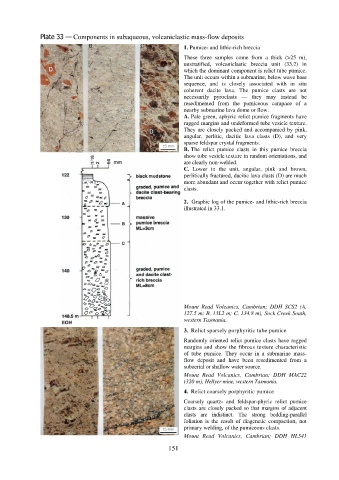
Plate 33 — Components in subaqueous, volcaniclastic mass-flow deposits
                                                                  1. Pumice- and lithic-rich breccia
                                                                  These three samples come  from a thick  (>25 m),
                                                                  unstratified, volcaniclastic  breccia unit (33.2)  in
                                                                  which the dominant component is relict tube pumice.
                                                                  The unit occurs within a submarine, below wave base
                                                                  sequence, and is closely associated with in situ
                                                                  coherent dacite lava.  The  pumice clasts are  not
                                                                  necessarily pyroclasts — they may  instead  be
                                                                  resedimented from the pumiceous carapace of  a
                                                                  nearby submarine lava dome or flow.
                                                                  A. Pale green, aphyric relict pumice fragments have
                                                                  ragged margins and undeformed tube vesicle texture.
                                                                  They are closely  packed and accompanied  by pink,
                                                                  angular, perlitic, dacitic lava clasts (D),  and  very
                                                                  sparse feldspar crystal fragments.
                                                                   B. The relict pumice clasts in this pumice  breccia
                                                                  show tube vesicle texture in random orientations, and
                                                                  are clearly non-welded.
                                                                  C.  Lower in the unit, angular, pink and  brown,
                                                                  perlitically fractured, dacitic lava clasts (D) are much
                                                                  more abundant and occur together with relict pumice
                                                                  clasts.

                                                                  2.  Graphic log of the pumice- and lithic-rich breccia
                                                                  illustrated in 33.1.


                                                                  Mount Read  Volcanics, Cambrian;  DDH SCS2 (A,
                                                                  127.5 m; B, 13L2 m; C, 134.8 m), Sock Creek South,
                                                                  western Tasmania.

                                                                  3.  Relict sparsely porphyritic tube pumice
                                                                  Randomly oriented relict pumice clasts have ragged
                                                                  margins and show the fibrous texture characteristic
                                                                  of  tube  pumice.  They occur in a submarine mass-
                                                                  flow deposit and  have been resedimented from a
                                                                  subaerial or shallow water source.
                                                                  Mount Read  Volcanics, Cambrian; DDH MAC22
                                                                  (320 m), Hellyer mine, western Tasmania.
                                                                  4.  Relict coarsely porphyritic pumice
                                                                  Coarsely quartz- and  feldspar-phyric relict pumice
                                                                  clasts are closely  packed so that  margins of adjacent
                                                                  clasts  are indistinct.  The strong bedding-parallel
                                                                  foliation is the result of diagenetic compaction,  not
                                                                  primary welding, of the pumiceous clasts.

                                                                  Mount  Read  Volcanics, Cambrian; DDH HL541
                                                            151

