


Page 165 - Volcanic Textures A Guide To The Interpretation of Textures In Volcanic Rocks
P. 165
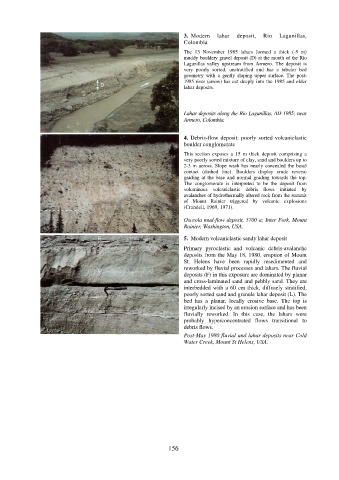
3.  Modern lahar deposit, Rio Lagunillas,
                                                                  Colombia

                                                                  The  13 November 1985 lahars formed a thick (-5 m)
                                                                  muddy bouldery gravel deposit (D) at the mouth of the Rio
                                                                  Lagunillas  valley  upstream from Armero.  The deposit is
                                                                  very  poorly sorted, unstratified and has a  tabular bed
                                                                  geometry  with  a  gently sloping upper surface.  The post-
                                                                  1985 river (arrow) has cut deeply into the 1985 and older
                                                                  lahar deposits.


                                                                  Lahar deposits along the Rio Lagunillas, AD 1985; near
                                                                  Armero, Colombia.

                                                                  4. Debris-flow deposit:  poorly sorted  volcaniclastic
                                                                  boulder conglomerate
                                                                  This section exposes a 15 m thick deposit comprising a
                                                                  very poorly sorted mixture of clay, sand and boulders up to
                                                                  2-3 m across. Slope wash has  nearly concealed the basal
                                                                  contact (dashed line). Boulders display  crude reverse
                                                                  grading at the  base  and normal grading  towards the  top.
                                                                  The  conglomerate  is interpreted to be the deposit  from
                                                                  voluminous volcaniclastic debris flows initiated by
                                                                  avalanches of hydrothermally altered rock from the summit
                                                                  of Mount Rainier triggered by volcanic explosions
                                                                  (Crandell, 1969, 1971).

                                                                  Osceola mud-flow deposit, 5700 a; Inter Fork, Mount
                                                                  Rainier, Washington, USA.

                                                                  5.  Modern volcaniclastic sandy lahar deposit
                                                                  Primary pyroclastic and volcanic debris-avalanche
                                                                  deposits from the May 18, 1980, eruption of Mount
                                                                  St. Helens  have been rapidly resedimented and
                                                                  reworked by fluvial processes and lahars. The fluvial
                                                                  deposits (F) in this exposure are dominated by planar
                                                                  and cross-laminated sand and pebbly sand. They are
                                                                  interbedded with a 60 cm thick, diffusely stratified,
                                                                  poorly sorted sand and granule lahar deposit (L). The
                                                                  bed has a  planar, locally erosive base. The top is
                                                                  irregularly incised by an erosion surface and has been
                                                                  fluvially reworked. In this case, the lahars were
                                                                  probably hyperconcentrated flows transitional to
                                                                  debris flows.

                                                                  Post-May 1980 fluvial and lahar deposits near Cold
                                                                  Water Creek, Mount St Helens, USA.


                                                            156

