


Page 166 - Volcanic Textures A Guide To The Interpretation of Textures In Volcanic Rocks
P. 166
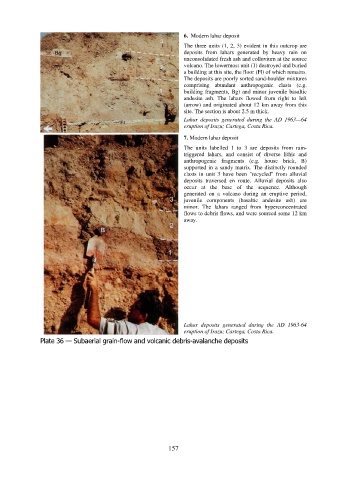
6. Modern lahar deposit
                                                                  The three units (1, 2, 3) evident in this outcrop are
                                                                  deposits from lahars generated by heavy rain on
                                                                  unconsolidated fresh ash and colluviurn at the source
                                                                  volcano. The lowermost unit (1) destroyed and buried
                                                                  a building at this site, the floor (Fl) of which remains.
                                                                  The deposits are poorly sorted sand-boulder mixtures
                                                                  comprising abundant  anthropogenic clasts (e.g.
                                                                  building fragments, Bg) and minor juvenile basaltic
                                                                  andesite ash. The lahars flowed  from right to left
                                                                  (arrow) and originated about 12 km away from this
                                                                  site. The section is about 2.5 m thick.
                                                                  Lahar  deposits generated during the AD  1963—64
                                                                  eruption of Irazu; Cartega, Costa Rica.

                                                                  7. Modern lahar deposit
                                                                  The  units labelled 1 to 3  are deposits from rain-
                                                                  triggered lahars, and consist of diverse lithic and
                                                                  anthropogenic fragments (e.g.  house brick, B)
                                                                  supported in a sandy matrix. The distinctly rounded
                                                                  clasts in unit 3 have  been "recycled" from alluvial
                                                                  deposits traversed en route. Alluvial deposits also
                                                                  occur at the base of  the sequence.  Although
                                                                  generated  on  a volcano during an eruptive period,
                                                                  juvenile components (basaltic andesite ash) are
                                                                  minor. The lahars  ranged from hyperconcentrated
                                                                  flows to debris flows, and were sourced some 12 km
                                                                  away.


                                                                  Lahar  deposits generated during the AD 1963-64
                                                                   eruption of Irazu; Cartega, Costa Rica.
               Plate 36 — Subaerial grain-flow and volcanic debris-avalanche deposits


                                                            157

