


Page 163 - Volcanic Textures A Guide To The Interpretation of Textures In Volcanic Rocks
P. 163
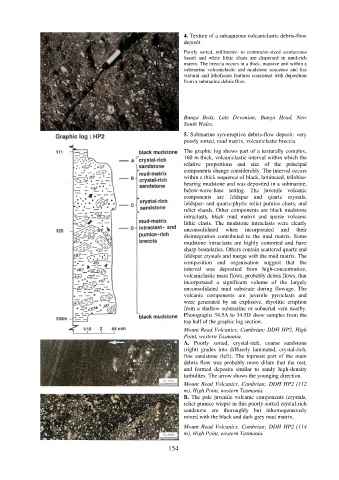
4. Texture of a subaqueous volcaniclastic debris-flow
                                                                  deposit

                                                                  Poorly  sorted, millimetre-  to centimetre-sized scoriaceous
                                                                  basalt  and white lithic clasts are dispersed in mud-rich
                                                                  matrix. The breccia occurs in a thick, massive unit within a
                                                                  submarine volcaniclastic and  mudstone sequence and has
                                                                  textural and lithofacies features consistent with deposition
                                                                  from a submarine debris flow.


                                                                  Bunga Beds,  Late Devonian; Bunga  Head, New
                                                                  South Wales.

                                                                  5. Submarine syn-eruptive debris-flow deposit: very
                                                                  poorly sorted, mud matrix, volcaniclastic breccia
                                                                  The graphic log shows part of a texturally complex,
                                                                  160 m thick, volcaniclastic interval within which the
                                                                  relative proportions and  size of the principal
                                                                  components change considerably. The interval occurs
                                                                  within a thick sequence of black, laminated, trilobite-
                                                                  bearing mudstone and was deposited in a submarine,
                                                                  below-wave-base  setting. The juvenile  volcanic
                                                                  components are feldspar and quartz crystals,
                                                                  feldspar- and quartz-phyric relict pumice clasts, and
                                                                  relict shards. Other components are black mudstone
                                                                  intraclasts, black mud matrix and sparse  volcanic
                                                                  lithic clasts. The mudstone intraclasts were clearly
                                                                  unconsolidated  when  incorporated  and  their
                                                                  disintegration contributed to the  mud matrix. Some
                                                                  mudstone intraclasts are highly contorted  and  have
                                                                  sharp boundaries. Others contain scattered quartz and
                                                                  feldspar crystals and merge with the mud matrix. The
                                                                  composition and  organisation suggest that  the
                                                                  interval was  deposited from  high-concentration,
                                                                  volcaniclastic mass flows, probably debris flows, that
                                                                  incorporated  a significant  volume of the largely
                                                                  unconsolidated  mud substrate during  flowage. The
                                                                  volcanic components are juvenile pyroclasts and
                                                                  were  generated by an explosive, rhyolitic eruption
                                                                  from a shallow submarine or subaerial vent nearby.
                                                                  Photographs 34.5A to 34.5D show samples from the
                                                                  top half of the graphic log section.
                                                                  Mount Read Volcanics, Cambrian; DDH HP2, High
                                                                   Point, western Tasmania.
                                                                  A. Poorly sorted, crystal-rich, coarse sandstone
                                                                  (right)  grades into diffusely laminated,  crystal-rich,
                                                                  fine sandstone (left). The topmost part  of  the main
                                                                  debris  flow  was probably more dilute that the  rest,
                                                                  and  formed deposits similar to sandy high-density
                                                                  turbidites. The arrow shows the younging direction.
                                                                  Mount Read Volcanics, Cambrian;  DDH  HP2 (112
                                                                  m), High Point, western Tasmania.
                                                                  B. The pale juvenile volcanic components (crystals,
                                                                  relict pumice wisps) in this poorly-sorted crystal-rich
                                                                  sandstone are thoroughly but inhomogeneously
                                                                  mixed with the black and dark grey mud matrix.
                                                                  Mount Read Volcanics, Cambrian;  DDH  HP2 (114
                                                                  m), High Point, western Tasmania.

                                                            154

