


Page 158 - Volcanic Textures A Guide To The Interpretation of Textures In Volcanic Rocks
P. 158
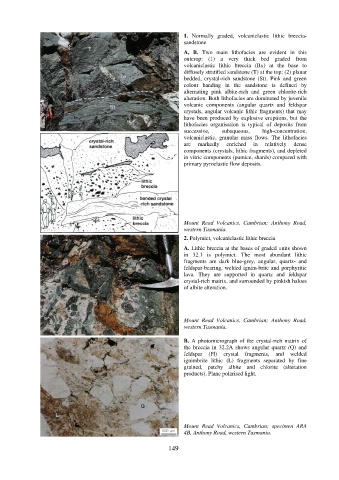
1.  Normally  graded, volcaniclastic lithic breccia-
                                                                  sandstone

                                                                  A, B. Two  main lithofacies are evident in this
                                                                  outcrop:  (1) a  very thick  bed graded from
                                                                  volcaniclastic lithic breccia (Bx) at the base to
                                                                  diffusely stratified sandstone (T) at the top; (2) planar
                                                                  bedded, crystal-rich  sandstone (St). Pink and green
                                                                  colour banding in the sandstone is defined by
                                                                  alternating  pink albite-rich and  green chlorite-rich
                                                                  alteration. Both lithofacies are dominated by juvenile
                                                                  volcanic components (angular quartz and feldspar
                                                                  crystals, angular volcanic lithic fragments) that may
                                                                  have been produced by explosive eruptions, but the
                                                                  lithofacies  organisation is typical of deposits from
                                                                   successive,  subaqueous,  high-concentration,
                                                                  volcaniclastic, granular mass flows. The lithofacies
                                                                  are  markedly  enriched  in  relatively  dense
                                                                  components (crystals, lithic fragments), and depleted
                                                                  in vitric components (pumice, shards) compared with
                                                                  primary pyroclastic flow deposits.


                                                                  Mount Read  Volcanics, Cambrian;  Anthony Road,
                                                                   western Tasmania.
                                                                  2. Polymict, volcaniclastic lithic breccia
                                                                  A. Lithic breccia at the bases of graded units shown
                                                                  in 32.1 is polymict. The  most abundant lithic
                                                                  fragments are dark  blue-grey, angular, quartz- and
                                                                  feldspar-bearing, welded ignim-brite and porphyritic
                                                                  lava. They are supported in quartz and feldspar
                                                                  crystal-rich matrix, and surrounded by pinkish haloes
                                                                  of albite alteration.


                                                                  Mount Read  Volcanics, Cambrian;  Anthony Road,
                                                                  western Tasmania.

                                                                  B. A photomicrograph of the crystal-rich  matrix of
                                                                  the breccia in 32.2A shows angular quartz (Q) and
                                                                  feldspar  (Fl) crystal fragments, and welded
                                                                  ignimbrite lithic (L) fragments separated by fine
                                                                  grained, patchy albite and chlorite (alteration
                                                                  products). Plane polarised light.


                                                                  Mount Read  Volcanics, Cambrian; specimen ARA
                                                                  4B, Anthony Road, western Tasmania.

                                                            149

