


Page 156 - Volcanic Textures A Guide To The Interpretation of Textures In Volcanic Rocks
P. 156
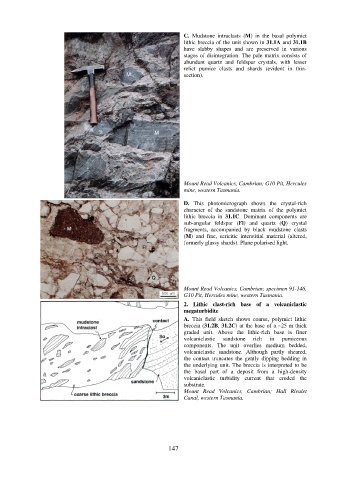
C. Mudstone  intraclasts (M) in the basal  polymict
                                                                  lithic breccia of the unit shown in 31.1A and 31.1B
                                                                  have slabby shapes and are preserved in various
                                                                  stages of disintegration. The pale matrix consists of
                                                                  abundant quartz  and feldspar  crystals, with  lesser
                                                                  relict pumice clasts and shards  (evident in thin-
                                                                  section).


                                                                  Mount Read Volcanics, Cambrian; G10 Pit, Hercules
                                                                  mine, western Tasmania.

                                                                  D. This  photomicrograph  shows the crystal-rich
                                                                  character of the sandstone  matrix of the polymict
                                                                  lithic breccia in  31.1C. Dominant components are
                                                                  sub-angular feldspar  (Fl)  and quartz (Q) crystal
                                                                  fragments, accompanied by black mudstone clasts
                                                                  (M) and  fine, sericitic interstitial  material (altered,
                                                                  formerly glassy shards). Plane polarised light.


                                                                  Mount Read Volcanics, Cambrian; specimen 91-146,
                                                                   G10 Pit, Hercules mine, western Tasmania.
                                                                  2.  Lithic clast-rich base of  a  volcaniclastic
                                                                  megaturbidite
                                                                  A.  This field sketch shows coarse, polymict  lithic
                                                                  breccia (31.2B, 31.2C) at the base of a ~25 m thick
                                                                  graded unit. Above the lithic-rich base is finer
                                                                  volcaniclastic  sandstone  rich  in  pumiceous
                                                                  components.  The  unit overlies medium bedded,
                                                                  volcaniclastic sandstone.  Although partly sheared,
                                                                  the contact truncates the gently dipping bedding in
                                                                  the underlying unit. The breccia is interpreted to be
                                                                  the basal  part of a  deposit from a high-density
                                                                  volcaniclastic turbidity  current that eroded the
                                                                  substrate.
                                                                  Mount Read Volcanics,  Cambrian; Hall Rivulet
                                                                   Canal, western Tasmania.


                                                            147

