


Page 153 - Volcanic Textures A Guide To The Interpretation of Textures In Volcanic Rocks
P. 153
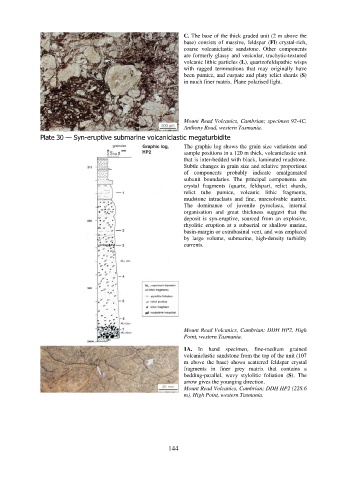
C. The base of the thick graded unit (2 m above the
                                                                  base) consists of massive, feldspar (Fl) crystal-rich,
                                                                  coarse  volcaniclastic sandstone. Other components
                                                                  are formerly glassy and vesicular, trachytic-textured
                                                                  volcanic lithic particles (L), quartzofeldspathic wisps
                                                                  with ragged terminations that  may originally have
                                                                  been pumice, and cuspate and platy relict shards (S)
                                                                  in much finer matrix. Plane polarised light.


                                                                  Mount Read Volcanics, Cambrian; specimen 92-4C,
                                                                   Anthony Road, western Tasmania.

               Plate 30 — Syn-eruptive submarine volcaniclastic megaturbidite
                                                                  The graphic log shows the grain size variations and
                                                                  sample positions in a 120 m thick, volcaniclastic unit
                                                                  that is inter-bedded with black, laminated mudstone.
                                                                  Subtle changes in grain size and relative proportions
                                                                  of components probably indicate amalgamated
                                                                  subunit boundaries. The  principal components are
                                                                  crystal fragments (quartz, feldspar), relict shards,
                                                                  relict tube  pumice, volcanic lithic fragments,
                                                                  mudstone intraclasts and fine, unresolvable  matrix.
                                                                  The dominance of juvenile pyroclasts, internal
                                                                  organisation and  great thickness suggest that the
                                                                  deposit is syn-eruptive, sourced  from an explosive,
                                                                  rhyolitic eruption at a subaerial or shallow marine,
                                                                  basin-margin or extrabasinal vent, and was emplaced
                                                                  by large  volume, submarine, high-density turbidity
                                                                  currents.


                                                                  Mount Read Volcanics, Cambrian; DDH HP2, High
                                                                  Point, western Tasmania.

                                                                  1A. In hand specimen, fine-medium grained
                                                                  volcaniclastic sandstone from the top of the unit (107
                                                                  m above the  base) shows  scattered  feldspar crystal
                                                                  fragments in finer grey  matrix that contains  a
                                                                  bedding-parallel, wavy stylolitic foliation (S). The
                                                                  arrow gives the younging direction.
                                                                   Mount Read Volcanics, Cambrian; DDH HP2 (228.6
                                                                  m), High Point, western Tasmania.


                                                            144

