


Page 148 - Volcanic Textures A Guide To The Interpretation of Textures In Volcanic Rocks
P. 148
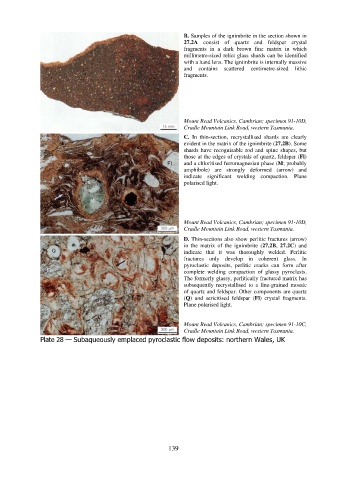
B. Samples of the ignimbrite in the section shown in
                                                                  27.2A consist of quartz and  feldspar crystal
                                                                  fragments  in a  dark  brown  fine matrix in  which
                                                                  millimetre-sized relict glass shards can be identified
                                                                  with a hand lens. The ignimbrite is internally massive
                                                                  and contains scattered  centimetre-sized lithic
                                                                  fragments.


                                                                  Mount Read Volcanics, Cambrian; specimen 91-10D,
                                                                   Cradle Mountain Link Road, western Tasmania.
                                                                  C. In thin-section, recrystallised shards are clearly
                                                                  evident in the matrix of the ignimbrite (27.2B). Some
                                                                  shards have recognisable  rod  and  spine  shapes, but
                                                                  those at the edges of crystals of quartz, feldspar (Fl)
                                                                  and a chloritised ferromagnesian phase (M; probably
                                                                  amphibole) are strongly deformed (arrow) and
                                                                  indicate significant welding compaction. Plane
                                                                  polarised light.


                                                                  Mount Read Volcanics, Cambrian; specimen 91-10D,
                                                                   Cradle Mountain Link Road, western Tasmania.
                                                                  D. Thin-sections also show perlitic fractures (arrow)
                                                                  in the matrix  of the ignimbrite (27.2B,  27.2C) and
                                                                  indicate that  it was thoroughly welded. Perlitic
                                                                  fractures  only develop in coherent  glass.  In
                                                                  pyroclastic deposits,  perlitic cracks can form after
                                                                  complete welding compaction of  glassy pyroclasts.
                                                                  The formerly glassy, perlitically fractured matrix has
                                                                  subsequently recrystallised to a fine-grained mosaic
                                                                  of quartz and feldspar. Other components are quartz
                                                                  (Q) and  sericitised feldspar  (Fl) crystal fragments.
                                                                  Plane polarised light.


                                                                  Mount Read Volcanics, Cambrian; specimen 91-10C,
                                                                  Cradle Mountain Link Road, western Tasmania.
               Plate 28 — Subaqueously emplaced pyroclastic flow deposits: northern Wales, UK


                                                            139

