


Page 161 - Volcanic Textures A Guide To The Interpretation of Textures In Volcanic Rocks
P. 161
(60.2 m), Hellyer mine, western Tasmania.
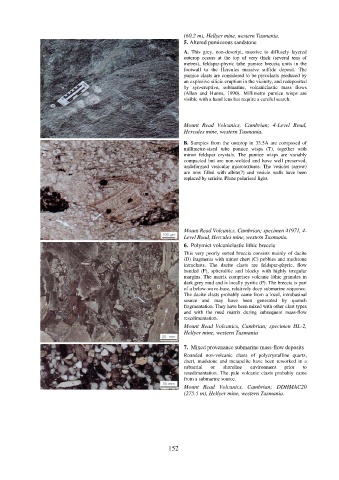
                                                                  5. Altered pumiceous sandstone

                                                                  A. This grey, non-descript,  massive to diffusely  layered
                                                                  outcrop occurs at the top of very thick (several tens of
                                                                  metres), feldspar-phyric  tube pumice breccia units in the
                                                                  footwall to the Hercules massive sulfide deposit. The
                                                                  pumice clasts are considered to be pyroclasts produced by
                                                                  an explosive silicic eruption in the vicinity, and redeposited
                                                                  by syn-eruptive, submarine, volcaniclastic mass flows
                                                                  (Allen  and Hunns, 1990). Millimetre pumice  wisps are
                                                                  visible with a hand lens but require a careful search.


                                                                  Mount Read  Volcanics, Cambrian;  4-Level Road,
                                                                  Hercules mine, western Tasmania.

                                                                  B.  Samples from  the outcrop in  33.5A are composed of
                                                                  millimetre-sized tube pumice  wisps (T), together with
                                                                  minor feldspar  crystals.  The pumice wisps are variably
                                                                  compacted  but  are non-welded and have well preserved,
                                                                  undeformed  vesicular microtextures. The vesicles (arrow)
                                                                  are  now  filled with  albite(?)  and  vesicle walls have been
                                                                  replaced by sericite. Plane polarised light.


                                                                  Mount Read Volcanics, Cambrian; specimen 41971, 4-
                                                                   Level Road, Hercules mine, western Tasmania.
                                                                  6.  Polymict volcaniclastic lithic breccia
                                                                  This very poorly sorted breccia consists mainly of dacite
                                                                  (D) fragments with minor chert (C) pebbles and mudstone
                                                                  intraclasts.  The dacite clasts are feldspar-phyric, flow
                                                                  banded (F), spherulitic  and  blocky with highly irregular
                                                                  margins. The matrix comprises volcanic lithic granules in
                                                                  dark grey mud and is locally pyritic (P). The breccia is part
                                                                  of a below-wave-base, relatively deep submarine sequence.
                                                                  The dacite clasts probably came from a local, intrabasinal
                                                                  source and may have been generated by quench
                                                                  fragmentation. They have been mixed with other clast types
                                                                  and with the  mud matrix during subsequent mass-flow
                                                                  resedimentation.
                                                                  Mount Read  Volcanics, Cambrian; specimen HL-2,
                                                                  Hellyer mine, western Tasmania

                                                                  7.  Mixed provenance submarine mass-flow deposits
                                                                  Rounded non-volcanic  clasts  of polycrystalline quartz,
                                                                  chert, mudstone and metapelite have been reworked in  a
                                                                  subaerial  or  shoreline  environment  prior  to
                                                                  resedimentation. The pale volcanic clasts probably came
                                                                  from a submarine source.
                                                                  Mount Read Volcanics,  Cambrian; DDHMAC20
                                                                  (275.5 m), Hellyer mine, western Tasmania.


                                                            152

