


Page 164 - Volcanic Textures A Guide To The Interpretation of Textures In Volcanic Rocks
P. 164
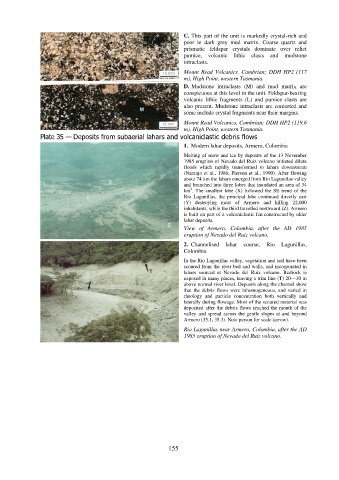
C. This part of the unit is markedly crystal-rich and
                                                                  poor in dark  grey mud  matrix. Coarse quartz and
                                                                  prismatic feldspar crystals dominate over  relict
                                                                  pumice, volcanic lithic  clasts and mudstone
                                                                  intraclasts.
                                                                  Mount Read Volcanics, Cambrian;  DDH  HP2 (117
                                                                  m), High Point, western Tasmania.
                                                                  D. Mudstone intraclasts (M) and mud matrix are
                                                                  conspicuous at this level in the unit. Feldspar-bearing
                                                                  volcanic lithic fragments (L) and  pumice clasts are
                                                                  also present. Mudstone intraclasts are contorted and
                                                                  some include crystal fragments near their margins.
                                                                  Mount Read Volcanics, Cambrian; DDH HP2 (119.6
                                                                  m), High Point, western Tasmania.
               Plate 35 — Deposits from subaerial lahars and volcaniclastic debris flows
                                                                  1.  Modern lahar deposits, Armero, Colombia
                                                                  Melting of snow and ice by deposits of the 13 November
                                                                  1985 eruption of Nevado del Ruiz volcano initiated dilute
                                                                  floods which rapidly transformed to  lahars downstream
                                                                  (Naranjo et al., 1986; Pierson et al., 1990). After flowing
                                                                  about 74 km the lahars emerged from Rio Lagunillas valley
                                                                  and branched into three lobes that inundated an area of 34
                                                                    2
                                                                  km . The smallest lobe (X) followed the SE trend of the
                                                                  Rio Lagunillas,  the principal lobe continued directly  east
                                                                  (Y) destroying most of Armero and killing 22,000
                                                                  inhabitants, while the third travelled northward (Z). Armero
                                                                  is built on part of a volcaniclastic fan constructed by older
                                                                  lahar deposits.
                                                                  View of Armero, Colombia, after the AD 1985
                                                                   eruption of Nevado del Ruiz volcano.
                                                                  2.  Channelised  lahar course, Rio Lagunillas,
                                                                  Colombia
                                                                  In the Rio Lagunillas valley, vegetation and soil have been
                                                                  scoured from the river bed and walls, and incorporated in
                                                                  lahars sourced  at Nevado del Ruiz  volcano. Bedrock  is
                                                                  exposed in many places, leaving a trim line (T) 20—30 m
                                                                  above normal river level. Deposits along the channel show
                                                                  that the debris flows were  inhomogeneous, and varied  in
                                                                  rheology and particle concentration both vertically  and
                                                                  laterally during flowage. Most of the scoured material was
                                                                  deposited after the debris flows reached the mouth of the
                                                                  valley and spread across the gentle slopes at and beyond
                                                                  Armero (35.1, 35.3). Note person for scale (arrow).

                                                                  Rio Lagunillas near Armero, Colombia, after the AD
                                                                  1985 eruption of Nevado del Ruiz volcano.


                                                            155

